Listen on your favorite platform.


Description
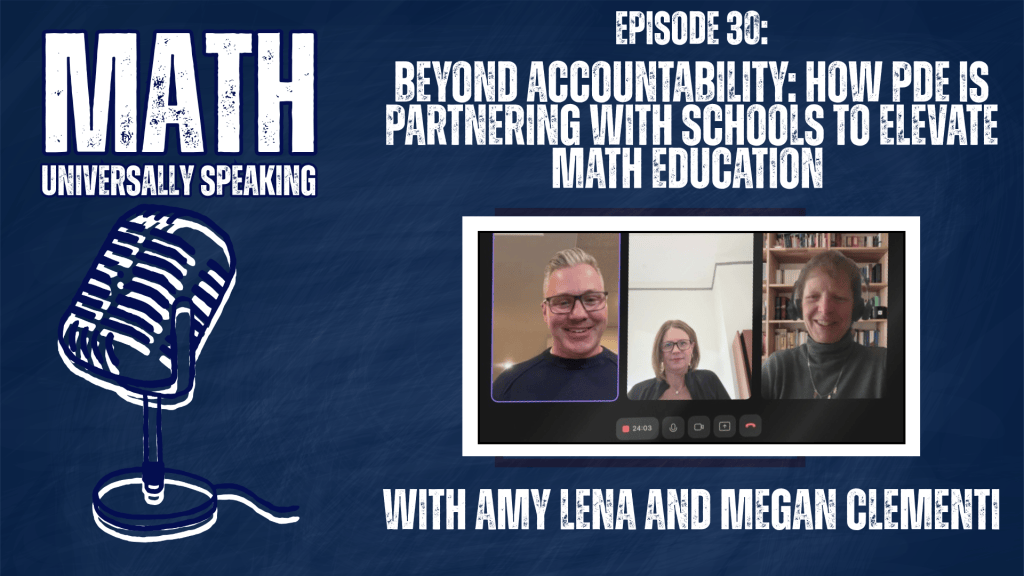
In Episode 30 of Math Universally Speaking, host Ron Martiello sits down with key leadership from the Pennsylvania Department of Education (PDE): Amy Lena, Deputy Secretary for Elementary and Secondary Education, and Dr. Megan Clementi, State Assessment Coordinator for Mathematics.
Together, they discuss a transformative shift in state education leadership—moving away from a traditional “accountability officer” mindset toward an active, supportive partnership with local schools, administrators, and classroom teachers.
In This Episode, We Cover:
- Reframing State Leadership: How PDE is prioritizing service, elbow-to-elbow support, and open collaboration with Pennsylvania school districts.
- Math Standards & Chapter 4 Updates: Insights into statewide listening sessions regarding potential revisions to PA Core Mathematics standards.
- The Rise of Data Literacy: Why data literacy and data science are critical components of modern math education and real-world student readiness.
- Overcoming Math Anxiety: Dr. Megan Clementi’s vision to eliminate math trauma and empower every student and educator to recognize that they are a “math person”.
- Free Educator Resources: How teachers and administrators can leverage free statewide tools, including the PA Standards Aligned System (SAS) website, the Assessment Builder, the Evidence Resource Center, and PVAAS data consultation services.
Show Notes
Amy Lena, Deputy Secretary for the Office of Elementary and Secondary Education
Amy Lena has extensive experience in education. Prior to joining the Department of Education in 2020, she worked in Pennsylvania and Massachusetts schools in various roles, including teacher, instructional technology coach, mathematics supervisor, supervisor of curriculum, instruction, and technology, and building principal. Since joining the Department, Amy has served as Advisor to the Deputy Secretary in OESE, as well as holding positions in the Bureau of School Support as Chief of the Division of Planning and Professional Development and Director of the Bureau. Amy’s career reflects a commitment to supporting underserved students and finding a balance between traditional educational methods and innovative approaches to ensure all students have an equitable path to on-time graduation.
Dr. Megan Clementi State Assessment Coordinator for Mathematics
Dr. Megan Clementi, State Assessment Coordinator for Mathematics at the Pennsylvania Department of Education, brings 27 years of experience as a classroom teacher and adjunct professor to her state leadership role. Driven by a mission to dismantle math anxiety and empower every student to believe they are a “math person,” her career spans 18 years teaching high school mathematics —from Algebra 1 through AP Calculus and AP Statistics—and 26 years instructing undergraduate, master’s, and pre-service education students. Today, along with overseeing Pennsylvania’s PSSA grades 3–8 math assessments and the Keystone Algebra I exam, she continues to serve in higher education as a doctoral dissertation advisor and instructor of Foundations of Educational Research Methods and Quantitative Educational Research Methods.
Dr. Clementi has spoken at NCTM and PCTM conferences over the years. She is a member of Association of State Supervisors of Mathematics (ASSM), National Council of Supervisors of Mathematics (NCSM), National Council of Teachers of Mathematics (NCTM), and Pennsylvania Council of Teachers of Mathematics (PCTM).
Pennsylvania Department of Education Resources
SAS Learning Communities: Online communities organized by subject area (including Mathematics, ELA, Science/STEELS, Social Studies, and the brand-new Data Literacy & Data Science community) where educators receive monthly newsletters and PDE updates.
SAS Assessment Builder: A free online tool allowing teachers to build classroom-level formative assessments, check student understanding, and create “tickets out the door” aligned to Pennsylvania state standards.
Curricular Documents: Free standards-aligned materials housed on the SAS portal, including PA Core Standards, Assessment Anchors, Eligible Content documents, and Performance Level Descriptors (PLDs).
Act 48 SAS Professional Learning Courses: Professional development courses hosted through the SAS platform for Pennsylvania educators.
Annual SAS Institute: PDE’s annual December conference held at the Hershey Lodge featuring over 150–180 breakout sessions, film screenings (such as Multiple Choice), and professional learning tracks across literacy, AI, CTE, and math.
Transcript
This transcript has been lightly edited and curated for clarity, readability, and flow, and is not a strict verbatim account.
Beyond Accountability: How PDE is Partnering with Schools to Elevate Math Education
Ron (00:55):
Hello friends, and welcome to Math Universally Speaking. I am so happy that you could join us today and you’re taking your valuable time to listen to our message about making math more inclusive for all students in your classes. Today we have two very special guests, two VIPs, two people who are definitely going to be able to help provide us with a wider perspective of mathematics instruction and be able to share some opportunities with us that we may not have realized in the past.
So I want you to make sure that you’re paying attention to the message that’s happening here. I met these two people in Hershey, the sweetest place on earth in Pennsylvania, at the SAS conference, which stands for Standards Aligned System. And so we want to make sure that we welcome our two friends from the Pennsylvania Department of Education: Deputy Secretary Amy Lena and State Assessment Coordinator for Mathematics, Dr. Megan Clementi. Good morning, how are you?
Amy Lena (01:58):
I’m doing well.
Megan Clementi (01:58):
Good morning.
Ron (01:59):
So I want to thank—Oh, this has been a—
Amy Lena (02:00):
Thanks for having us.
Megan Clementi (02:01):
Thank you for having us.
Ron (02:03):
—couple months in the making, and I’m so glad that we’re doing it. If you could just start by sharing a bit about your backgrounds as educators and the experiences that led you to your current roles in PDE.
Educator Backgrounds and Pathways to PDE
Megan Clementi (02:15):
So I have taught high school courses, undergraduates, and graduate students for 27 years. As a teacher and an adjunct professor, I encountered many, many students with tremendous math anxiety and math trauma. These students often proclaimed, “I’m just not a math person.”
And so I crafted a vision statement that all students I worked with—high school students, undergraduate students, graduate students, pre-service teachers—would all come to believe that they are math people.
When I was teaching high school courses, I had administered the PSSA grade 11 way back—there were still dinosaurs on the earth—and also the Keystone Algebra 1 exam. As a high school teacher, I taught 18 years: Algebra 1, Geometry, Algebra 2, Pre-Calculus, AP Calculus AB, Intro to Statistics, and AP Statistics.
I also taught undergrads for 26 years and pre-service teachers in that program, master’s degree students for a number of years. And right now I just teach doctoral students. I serve as a dissertation advisor, and I teach research methods and quantitative education research methodology at the doctorate level.
In my role right now, I serve as the State Assessment Coordinator for Mathematics, which means I oversee all the aspects of PSSA mathematics grades three through eight and also the Keystone Algebra One exam. I joined PDE in 2022, and it has been a wonderful five years.
Ron (04:08):
That’s wonderful, Megan. That’s a wide-spanning career, lots of different experiences there. Amy, how about you?
Amy Lena (04:17):
So I always like to say that my mom knew I was going to be an educator long before I did. My mom was a teacher, principal, curriculum director, and eventually a superintendent. And then from the time I was little, I was always playing school. So she taught me I’d be a teacher someday. So of course I thought I knew better and went to school to become an accountant. And it was between my sophomore and junior year of college, I was working with children at the YMCA’s before and after school program and their summer camp.
And it’s when I switched to education where I belong. And she was right—we’re going to have to share this podcast and tell her she was right. I actually began my career in elementary ed with a focus on math, and I was the only student teacher placed in a middle school. So it was an interesting experience. And then my first teaching assignment was actually in eighth grade. I taught English, social studies, science, and math—back when you could do all those, so I was three tested subjects.
That experience really sparked my passion for math education and making a difference with students who felt that they didn’t belong in a math classroom. So I went back to earn my secondary math certificate while completing my master’s degree. And then throughout my career, when I was a classroom teacher, I became a math supervisor, elementary principal, district-level administrator. I always was a strong advocate for math education. One thing that has stayed with me is how often students convince themselves they’re just not good at math, as Megan has said. And once they believe they aren’t good at math, it really limits what they think they’re capable of accomplishing. I’ve always believed that every student has potential, every student can learn math, and every student deserves to feel successful.
After working at the classroom, building, and district levels, the opportunity to join PDE was really exciting to me because it had a chance to take that same passion and have an impact statewide. So today as Deputy Secretary for Elementary and Secondary Ed, I have the opportunity to shape policies and initiatives that support students, teachers, and leaders across Pennsylvania. And while my role has certainly changed, my belief hasn’t—I truly believe every student can learn math.
And our responsibility as educators is to help them believe that too. And it’s what I love about being a math teacher is seeing them go from “I don’t think I can do this” to saying, “Oh my gosh, I can do it.” And it still gets me excited.
Current Trends and Conversations in Pennsylvania Math Education
Ron (06:49):
And this is what I came away from at the conference was getting to know you both a little bit better, speaking to you personally, listening to you speak at the conference. You know, we get emails on the other side. We get emails with the names of people and things that we have to do and responsibilities that happen, but there are people who share our mission on the other side of those emails who are making the policies and doing the good work at the state level. So that’s why I asked you to be on the podcast. So in that same spirit, universally speaking, what are the most significant trends or conversations currently shaping mathematics education across our state of Pennsylvania?
Megan Clementi (07:29):
That’s a great question, Ron. So our PA Core mathematics standards and accompanying assessment anchors and eligible content documents, as well as the performance level descriptors—that’s a whole lot of words for some actual documents that we use for our state assessments and for our standards. These were last updated in 2014-2015.
Work actually began, of course, long before that. In July of 2010, the State Board adopted the Common Core Standards, and then the board subsequently revised the Common Core Standards and adopted the PA Core standards in math of 2012, finalizing revisions to those in September of 2013. So it’s been a while.
This past spring, the State Board asked PDE to conduct listening sessions across the Commonwealth to determine if the State Board should open the mathematics and ELA standards to review them and possibly revise the standards.
PDE held four listening sessions: one in July, one in August, one in September, and one just two weeks ago in October.
We gathered information from K-12 educators, career and technology teachers, higher education faculty, higher education admissions representatives, business, and industry individuals during these meetings. And we asked two centering questions:
- Should the State Board open the standards, which are specifically housed in Chapter 4 (where our ed regulations live)?
- What is the mathematics that our students need to know to be prepared for career and post-secondary work?
So we held these four listening sessions. We’re in the process of putting our report together, and Amy will deliver that report to the State Board in the coming months, and then the State Board ultimately will make the decision if we should open our mathematics and ELA standards. That’s really centering a lot of our work right now.
Amy Lena (10:11):
One of the conversations I think is especially important is about data literacy. So Megan actually led a data literacy summit that brought together educators from across Pennsylvania. And one of the biggest takeaways was that everyone is a math teacher. So we sometimes hear everyone is a reading teacher, but we don’t ever hear that everyone is a math teacher.
Ron (10:32):
No, we don’t.
Amy Lena (10:34):
Along with IU3, Megan gathered a team of math and STEM specialists from intermediate units and applied for a $20,000 grant from Data Science for Everyone in the spring of 2025. Pennsylvania was one of the three states chosen to lead a data literacy call to action. We have planned the event for the past 15 months and held the call to action on October 6, 2026.
At the call to action, K-12 educators, higher ed faculty, business and industry, IU personnel, and administrators had rich experiences with data through slow reveal graphs. I think this is important too about what Megan said, and then what I’m saying here is that we’re no longer limiting the math education conversation to K-12. It is really looking at where a student has come from in that preschool world all the way to having a job. And so we’re bringing everyone to the table when we’re talking about standards and when we’re talking about what needs to happen within math education, such as data literacy. So I just wanted to point that out, that we really have a whole new thought process behind this. And I’m super excited about that because everyone is coming to the table.
Ron (11:52):
That’s awesome. And I imagine you’re able to more easily connect with people across the state better in 2026 than you were in 2010, 2011, or 2012, when these other standards were being developed.
Amy Lena (12:07):
Yes, and you know, those standards—I always laugh because I was on that committee. My youngest was three, and now she’s a senior, so her whole life has been under the same standards. So it’s time for a change. But I also think while we’re looking at a change, I appreciate this time because we might have missed something as important as data literacy if it had happened earlier. COVID is what really interrupted the process, but maybe it was actually a blessing in disguise, right? Let’s look at some positives that came from that. We now can connect with people better, we are seeing things differently, and we are bringing more people to the table.
We really live in a world surrounded by data, and students are seeing graphs and statistics all over the news and social media algorithms—your Netflix algorithm, right? That’s all math, and people are missing it. So we can’t let people just have things happen to them; they have to understand what is happening, and math is going to help them. These are essential life skills regardless of career.
It’s not just about building students who can perform calculations or solve equations. We want math to turn them into critical thinkers. That’s why I used to tell my algebra students, “Yes, you may not use exponent rules tomorrow in your job.” That would be sad to me because I love exponential rules, but I understand you may not sit there and need to remember if you add, multiply, or subtract exponents. However, I’m teaching you to think critically, think logically step by step, ask questions, make informed decisions, and understand what’s happening around you. That’s kind of where we’re headed with math education and this data literacy.
Ron (14:18):
That’s wonderful. And you know what? You kind of gave us a little teaser last December about what was going on, and I wanted to know more about that. So I’m glad that you shared. There’s a lot of work that happens behind developing these standards, and I’ve heard podcasts from other mathematicians across the country saying these standards need to change, we need to update them and include data literacy.
Partners and Supporters: Reframing PDE’s Role
Ron (15:00):
When I attended the SAS Institute Conference last December, I heard something that really stood out to me. You talk about all the nuts and bolts of things and getting people together, and that’s wonderful. But what really stood out to me was that PDE staff don’t see themselves as accountability officers. When teachers see these standards, it’s like, “I have to teach these things.” The accountability piece is there, but you don’t want to be seen as accountability officers; you want to see yourselves and the department as supporters of schools and educators. Why is cultivating this spirit of partnership with schools so vital to your mission?
Megan Clementi (15:15):
That is a great question, Ron, because you hit the nail on the head. Amy and I do not view ourselves as accountability officers, but partners and supporters. What grounds me every day is my firm belief that every person is a math person. To see that vision come to fruition, I see my role as one of service to students, teachers, and administrators.
My position overseeing all aspects of state assessments really goes beyond that, especially with curriculum and instruction, because curriculum, instruction, and assessments should all be aligned—there should be a through line between all of those. In my position, I am fortunate enough to work with educators from across the Commonwealth and look at every assessment question to ensure that the questions students encounter on the PSSA and the Keystone Algebra 1 exam are fair.
There are some questions that are easy, some middle of the road, and some that are difficult, but in crafting the questions, the teachers and I examine alignment, vocabulary choice, word choice, and context. And when teachers reach out with questions about the standards, assessment anchors, or eligible content, I see my role as one of service. When I get questions from educators via email, Teams, or Zoom calls, my first question to them is always, “How can I help? What can I help you with? Where is your area of concern? And how can I either provide the information or put you in contact with the person who does?”
Ron (17:50):
That’s wonderful. Amy, do you have anything to add there?
Amy Lena (17:54):
Yeah, it’s something that we really feel strongly about. It comes straight from our Secretary, Dr. Ro, who really believes that we are here to provide assistance at PDE and not to be someone who comes down on schools. Yes, we have to follow the law and school code, but having spent so much of my career in schools and districts, I understand what it’s like to be on the other side of state requirements and standards. The standards are there so we know we’re holding all students to the same standard, but we also have to think about what’s best for students as a whole.
So we’re asking, “How can we help schools be successful? What do they need? What challenges are they facing? How can we work together?” We try to be out and about and hear from people, because what one LEA is facing may be very different than another in our diverse state. At the end of the day, we all want the same thing: we want every student in Pennsylvania to have the opportunity to learn, grow, and succeed. PDE is here to help, and we hope everyone reaches out and asks us for support.
Ron (19:41):
I’ll go back to my experience: I was a principal for eight years, and two years as an assistant before that. One of the things I learned from great leaders around me was, “We have responsibilities, but I’m here next to you, elbow to elbow, to support you.” That’s why I’m so happy you shared that message, because sometimes teachers are so far removed that they don’t know what that support looks like. And as you said, it’s differentiated because of our diverse state. Speaking of that statewide perspective, what specific resources or initiatives does PDE provide to help teachers elevate their math instruction in their classrooms for all students?
Free Resources for Teachers and Administrators
Megan Clementi (20:24):
This is another great question, Ron. We have tremendous resources on our SAS (Standards Aligned System) website. Every educator in Pennsylvania can sign up for a free account and find these tremendous resources.
Within the website, we have dozens of SAS learning communities for mathematics, science, social studies, ELA, and a brand new one for data literacy and data science that was revealed at our call to action summit two weeks ago. Members receive regular newsletters and updates.
We place tremendous resources on there, from curricular documents to an assessment builder where teachers can build classroom assessments to use as formative tools. Our SAS website truly is a fabulous, free resource for our educators.
Ron (22:11):
I’ll be using that Assessment Builder with some of the teachers in my district in an upcoming PD. My supervisor specifically highlighted that we need to get that tool into the hands of our teachers.
Megan Clementi (22:22):
And it’s all free! Exactly.
Amy Lena (22:25):
And it’s based on the Pennsylvania standards, making it an amazing tool for formative assessments or quick check-ins like exit tickets. I wish I had this when I was in the classroom.
Megan Clementi (22:44):
A lot of educators don’t even know the SAS website exists, so I’m hoping this podcast helps spread the word about these free resources.
Ron (23:02):
They’re free, ladies and gentlemen! For administrators striving to improve math achievement, what opportunities does PDE offer for school leaders to partner with you?
Megan Clementi (23:19):
Every December, PDE hosts the SAS Institute at the Hershey Lodge. It features dozens of presentations over four days (Sunday through Wednesday) given by Pennsylvania educators, PDE staff, IU personnel, and administrators. The feedback from participants is tremendous. This year, the institute runs from December 6 through December 9.
Amy Lena (24:29):
It has grown so much that it’s now a full Sunday-through-Wednesday event. On Sunday, December 6, we are featuring a movie called Multiple Choice, which explores infusing Career and Technical Education (CTE) for all students. We’ll also cover structured literacy and AI on Sunday, followed by 150 to 180 breakout sessions throughout the conference.
I also want to highlight Pennsylvania’s Evidence Resource Center (ERC), which has been available since 2018. It provides educators with access to strategies backed by peer-reviewed research so they can make informed decisions rather than relying on guesswork or paid promotions.
One simple, highly effective strategy listed on the ERC is regular text communication with parents regarding learning progress and homework. Research proves this boosts student achievement across subjects, attendance, and graduation rates. Improving math doesn’t always require expensive new curricula; sometimes it’s as simple as strengthening parent communication.
Additionally, we offer administrative learning through the Pennsylvania Inspired Leadership (PIL) program, offering courses that help school leaders analyze their own district data in context to drive instructional leadership.
Ron (30:12):
The show notes are going to be chock full of resources! I can’t wait for the SAS conference in Hershey this December where I’ll be presenting on Monday afternoon. The PIL courses and contextual data analysis are incredibly valuable for time-stretched administrators.
Amy Lena (31:10):
Another key resource for administrators is our PDE PVAAS team. Administrators can email the PVAAS team, and an expert will meet with them one-on-one for free to analyze their data and pull out actionable insights. With administrators juggling recess, buses, discipline, and observations, having a dedicated data expert guide those conversations makes teacher coaching far more meaningful. I took advantage of that every year as an administrator.
Looking Forward: Hope for the Future of Math Education
Ron (32:34):
We talked about the pressures on administrators and teachers, but there is hope to be gained. From your vantage point, what gives you the most hope about the future of mathematics education in Pennsylvania?
Megan Clementi (32:57):
Every person is a math person. That vision statement grounds my daily work. I am hopeful that the State Board will allow us to open Chapter 4 to update our mathematics standards and content. I’m already thinking about implementation and the support teachers and administrators will need using our SAS website, Evidence Resource Center, and recently adopted STEELS standards.
Nationally, Amy and I participate in conversations with the Council of Chief State School Officers (CCSSO). Pennsylvania is also part of the Launch Years initiative with the Dana Center at UT Austin, exploring high school mathematics pathways to ensure clear alignment between high school coursework, higher education, and modern careers.
Our recent Data Literacy Summit Call to Action brought together over 200 educators across Pennsylvania, sending an urgent message: students live in a data-rich world, and we must prepare them for careers—many of which don’t even exist yet.
Additionally, I am attending the Association of State Supervisors of Mathematics conference and meeting with Student Achievement Partners (SAP). SAP has taken a deep dive into Algebra 1, Geometry, and Algebra 2 to define the essential core components of those courses, which will help guide our state conversations on standards revisions.
Amy Lena (36:52):
What gives me hope is the dedication of educators across Pennsylvania. When I visit schools and talk with teachers and leaders, I see firsthand a growing recognition that math isn’t just about getting the right answer—it’s about problem-solving, critical thinking, and preparing for a changing world. Every student has the ability to learn math, and our educators are committed to helping them see that.
Ron (37:32):
That’s fantastic! It’s awesome that you’re working with Student Achievement Partners—I previously interviewed Jennie Beltramini from SAP, and they are doing wonderful work elevating instruction while ensuring all kids feel a sense of belonging.
Megan Clementi (37:58):
Absolutely. Focusing on the core components of Algebra 1, Geometry, and Algebra 2 is key. As Amy mentioned, while missing exponent rules might make us sad, the ultimate goal is teaching students to think logically, approach problems from different angles, and develop a flexible problem-solving mindset.
Closing Messages for Educators Worldwide
Ron (38:41):
As we wrap up, I know we’ve focused a lot on Pennsylvania. But as a kid from a row home in Northeast Philadelphia, it’s amazing to have a platform connecting with educators from Canada, Germany, and around the world. Do you have a message for our listeners beyond Pennsylvania?
Megan Clementi (39:09):
Every student is a math person. Every parent is a math person. Every educator—teachers, administrators, PDE staff, IU personnel—is a math person. Our future is very bright, and I am excited for what’s next for our learners and educators. Thank you for having us, Ron; this has been wonderful.
Amy Lena (40:00):
Never underestimate the incredible influence you have on how students see themselves as learners. Beliefs like “I’m not good at math” start young and stick with students forever. Help students understand that struggling with a problem doesn’t mean they aren’t capable; math is about thinking, making connections, and learning from mistakes. There’s a reason math pencils have erasers!
For school leaders, create environments where teachers feel supported to try new approaches, collaborate, and make math relevant. Every student has potential, and sometimes it just takes one educator who believes in them. Thank you so much, Ron!
Megan Clementi (41:24):
We could talk about math all day long!
Ron (41:27):
We really could! Thank you both so much for sharing your vision of community, support, and partnership. To our listeners, please explore the resources from the Pennsylvania Department of Education, and if you’re outside PA, reach out and connect so we can work together to ensure all students know they are math people.
Professional Development Questions
- Leveraging Free Tools for Formative Assessment
- How can we more effectively integrate free tools like the SAS Assessment Builder into our routine instruction to check for student understanding in real time, rather than relying solely on end-of-unit summative tests?
- Embedding Data Literacy Across Content Areas
- Given that data science and data literacy shape so much of our students’ daily lives and future careers, what is one concrete way we can weave real-world data analysis (such as slow-reveal graphs or algorithm discussions) into our current curriculum?
- Shifting Mindsets Around Math Identity
- What specific classroom practices can we implement this term to help students reframe productive struggle and mistake-making, moving them away from the “I’m just not a math person” mindset toward seeing themselves as capable problem-solvers?
References
Google. (2026). Gemini (Large language model). Assisted in transcribing, formatting, and generating episode summary and professional development materials.https://gemini.google.com


Leave a Reply