Listen on your favorite platform.




Description
How can we break down barriers in elementary math and design instruction where every student thriHow do Universal Design for Learning (UDL) and Multi-Tiered System of Supports (MTSS) intersect to make K–12 mathematics accessible for every learner?
In this episode of Math Universally Speaking, host Ronald Martiello connects with Fred Cochran—a 28-year educator, MTSS Lead, and co-founder of the California UDL Coalition. Fred shares his decade-long journey of integrating UDL into MTSS and explains how educators can shift UDL from being “one more thing” to becoming a daily teaching habit.
Key Topics Covered:
- Systemic Alignment: Using UDL as the Tier 1 foundation within MTSS.
- Math Accessibility: Moving from procedural memorization to meaningful conceptual understanding.
- Overcoming Barriers: Shifting mindsets to ensure all students thrive in general education spaces.
- UDL Community: The story behind the California UDL Coalition and details on the upcoming 4th Annual UDL Summit.
Show Notes
Fred Cochran is a Coordinator for Continuous Improvement and Support at the San Joaquin County Office of Education. With 27 years in education, he has served as a primary teacher, English Language Development (ELD) instructor, instructional coach, site administrator, and adjunct instructor for Teachers College of San Joaquin. Fred also serves as the San Joaquin County co-lead for the Multi-Tiered System of Support (MTSS) and is actively involved in the California Coalition for Inclusive Learning
Transcript
This transcript has been lightly edited and curated for clarity, readability, and flow, and is not a strict verbatim account.
Connecting UDL and MTSS: Proactive System Design and Math Accessibility with Fred Cochran
Introduction & Background
Ron:
Hello, friends, and welcome to another episode of Math Universally Speaking! Today, we are making an East Coast–West Coast connection when it comes to Universal Design for Learning (UDL). I have my new friend, Fred Cochran. Fred, how are you doing today?
Fred:
Hey, Ron! I’m doing great today. Thanks for the introduction.
Ron:
This interview has been a couple of months in the making, and you and I have had a few great chats over that time. Why don’t you let the audience know a little bit about yourself and your role in education?
Fred:
I’d be happy to. I bring 28 years of experience in education—I’m a bit of a veteran at this point! I began as a second-grade teacher. I was excited because I knew I could write a sentence and do the math, so I figured the kids wouldn’t be smarter than me quite yet!
I taught second grade for about five years before discovering a real passion for working with newcomer students arriving in California from multiple countries. I led a newcomer classroom, worked as an instructional coach and an administrator, and for the last 12 years, I’ve served as a Lead for Multi-Tiered System of Supports (MTSS). That work naturally led me into Universal Design for Learning.
Discovering UDL Through the MTSS Framework
Ron:
In our prior conversations, you mentioned backing into UDL through the MTSS process. When did you first make that connection?
Fred:
It was about 10 years ago when MTSS became a major focus here in California. All county offices across the state were participating in a large grant initiative to define what MTSS could look like. Our department was very small at the time—just two of us—but we were trained by SWIFT Schools out of the University of Kansas, and I became an MTSS Lead for our county office in Stockton (San Joaquin County).
We support 14 school districts. Schools applied to participate in the grant, and I facilitated a district with two high schools and about six or seven elementary schools.
Where this gets interesting is through an assessment tool called the Fidelity Integrity Assessment (FIA). Part of the FIA explicitly asks: “How is Universal Design for Learning implemented in your school?” When I first saw that, I realized, “Oh my gosh, I don’t even know what this is.”
In this line of work, you want to know your stuff! So I read everything I could get my hands on regarding UDL to build my baseline understanding. Then, I reached out to other county offices across California, asking, “Where is this actually happening in real time? I need concrete examples so I can be credible.” Little by little, it grew. That moment jumpstarted a 10-year journey with UDL that hasn’t stopped since.
Ron:
We have to give a shoutout to our mutual friend, Beth Stark from Germany, who introduced us a few months back. She has been wonderful in helping deepen my understanding of UDL as well.
I really resonate with what you said—when you encounter something in a framework you’re supposed to train others on and realize you don’t know it deeply yet, you have to do your homework and seek out practical examples.
Fred:
I have a fun story about Beth! At the 2024 UDL International Conference in Sacramento, I was presenting, but I made sure to sit in on one of her sessions. I had been following her work because she and Jeremy Roston created LUDIA, an incredible AI chatbot built specifically around UDL.
When I met her, she looked at me and said, “I know you! You created the UDL Toolkit LiveBinder—I use that and love it!” It was an immediate mutual connection. It’s been really rewarding to hear educators say the toolkit helps them curate and navigate the vast amount of UDL resources out there. Beth and I continue to meet up whenever we can, and she is an amazing colleague.
Ron:
Absolutely. LUDIA is a mainstay tool in my coaching kit, especially when guiding teachers through the UDL framework.
Making UDL Practical: Content Connections & Overcoming Barriers
Ron:
As you continue this work with MTSS and UDL, what is one of the hottest topics you’re navigating right now?
Fred:
Connecting UDL explicitly to different content areas. UDL isn’t a curriculum, nor is it designed for just one specific subject. Explaining that distinction and making it a practical reality for teachers can be a challenge.
I’m still surprised at presentations by how many educators haven’t encountered UDL yet. But when you anchor it to real-world context, you can pull out UDL considerations anywhere.
In mathematics, this is critical. We need to create relevant, authentic connections so students understand why math matters in their daily lives. We live in science, but we also live in mathematics. I wasn’t a great math student as a child, but when I became a teacher, I learned how to conceptualize math. Teachers need to build models where students experience mathematics in ways that are deeply meaningful and connected to real life.
Ron:
I remember my own school experience. I was constantly trying to make conceptual sense of math, but I felt suppressed by a traditional procedural mindset—memorizing steps without the context. Educators had good intentions back then, but we know better now. Frameworks like UDL ensure mathematics is accessible to every child.
What are some of the common barriers to inclusive practices you see in school districts, and how do you help address them?
Fred:
The biggest hurdle is helping people realize that UDL is not “one more thing to do”—it is the thing to do.
When you center your practice around a framework that proactively provides accessible options, you set everyone up to win. However, asking teachers to let go of comfortable, long-standing practices can be scary.
We also need to shift away from siloed mindsets where certain kids are viewed as “someone else’s responsibility.” All students in a building are General Education students first, with supports wrapped around them. Inclusion means all means all.
Another perspective is building habits. A good habit is something beneficial you do every day—whether it’s exercising, drinking your morning coffee, or taking your daily medication. In teaching, designing with UDL needs to become a habit because it’s the right thing to do and our students deserve flexible pathways to learn and demonstrate their understanding. Having that short “elevator speech” ready helps open conversations and allows us to listen to what barriers are keeping teachers from embracing inclusive mindsets.
Ron:
Listening to teachers is so critical. People often tie their identity to teaching practices they feel comfortable with and get decent results from. When we ask them to shift, we have to help them see the bigger picture: examining variability, identifying learning barriers proactively, and building options right into the design. Making UDL an intentional habit is a fantastic framing.
Building the California UDL Coalition & Annual Summit
Ron:
You’ve done extensive work in California establishing a UDL coalition. Could you tell us about that initiative?
Fred:
I’d love to! Years ago, county offices across California were working in UDL silos—one county doing this, another hiring a consultant, but without a shared vision.
One day, I called a colleague in Southern California and said, “I’m up in Northern California, you’re down south—what if we connected all the county offices to build a unified voice for UDL?”
That birthed the UDL Network. We met four times a year to showcase schools, share stories, and highlight research. Eventually, we expanded beyond county offices and opened access statewide to teachers, administrators, and university students.
To formalize our work, we modeled our operational structures after the PBIS Coalition, drafting bylaws, procedures, and policies to establish the California UDL Coalition.
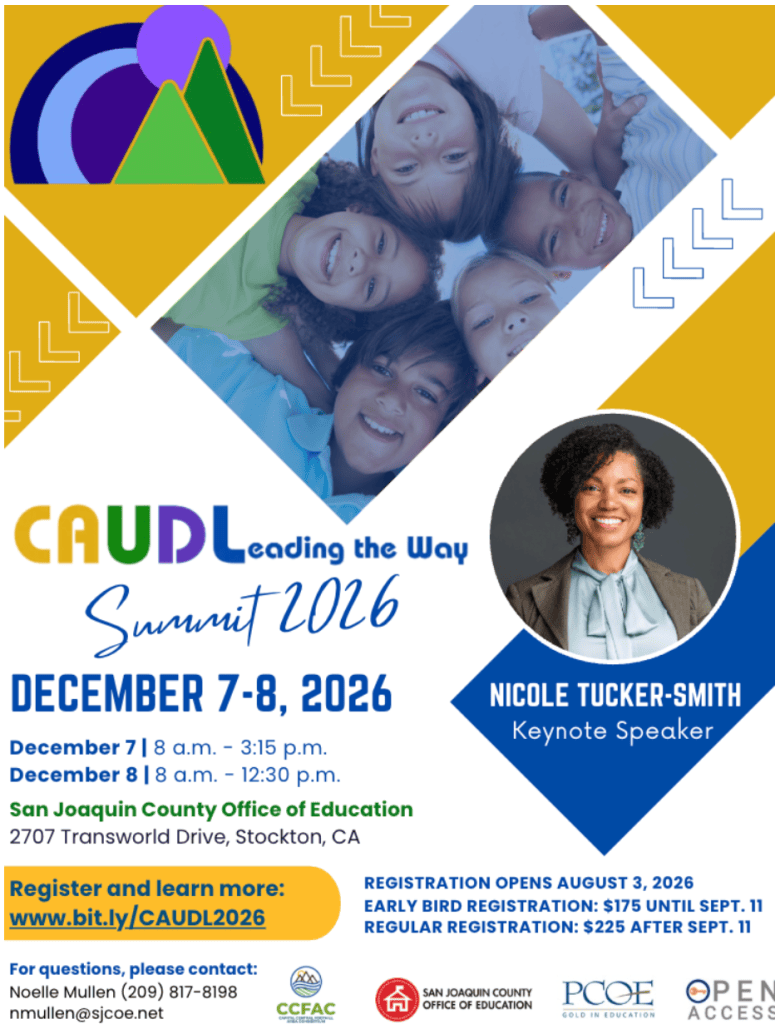
To build momentum, we decided to host a showcase event. Partnering with our regional Geographic Lead (Geo Lead), we launched the California UDL Leading the Way Summit.
What started as a one-day experimental event has grown exponentially. We are currently hosting our 4th Annual Summit on December 7th & 8th in Stockton, California!
Ron:
That’s amazing! December 7th and 8th. Do you mind if I share the link details in our show notes so listeners can find it?
Fred:
Please do! Listeners can visit bit.ly/CAUDL2026 to see our event details, agenda, and speakers.
This year, our keynote speaker is the incredible Nicole Tucker Smith. In past years, we’ve hosted Dr. Shelley Moore and Emily Massabni Luna from Novak Education. We keep registration very affordable—only $225 for two full days—because our primary goal is making high-quality professional learning accessible.
We welcome attendees from everywhere! We have teams coming from across California, and last year we even had a team of 24 join us all the way from Washington State. (If your listeners haven’t checked out Shelley Moore’s YouTube channel, Five Minute Lessons, I highly recommend it!)
Finding Joy in Educational Leadership
Ronald:
Fred, we’ve covered a lot of ground today. Before we wrap up, can I ask you one off-script question?
Fred:
Of course!
Ron:
You’ve been in education for 28 years, yet your energy and passion are so evident. What keeps bringing you joy in this work?
Fred:
I am a networker at heart. I love people, and I love connecting ideas.
When you look at systems like MTSS, it’s like furnishing a house with everything you need: PBIS, RTI, Social-Emotional Learning, and UDL driving Tier 1 core instruction. When you can help educators see how all these initiatives fit together seamlessly, the lightbulbs go off. Making sense of complex systems so that it directly impacts a child—that’s what excites me every single day.
Ron:
I deeply value our connection, Fred. You bring a wealth of experience, and viewing UDL and MTSS as connected, systemic frameworks is key to moving schools forward for kids. Do you have any final thoughts for our listeners today?
Fred:
Every learner deserves access to meaningful, rigorous mathematics so they can tackle life’s challenges. Our job as educators is to design the conditions in which all students can thrive—and mathematics is a crucial key to that success.
Ron:
A perfect closing word. Friends, make sure to check out the show notes for links to Fred’s resources and the upcoming UDL Summit in December. Thank you so much for your time today, Fred!
Fred:
Thank you, Ron. It was a pleasure being here!
Professional Development Questions
- Systems Integration & Alignment
Question: In the episode, Fred Cochran describes UDL as the primary driver for Tier 1 core instruction within an MTSS framework rather than “one more thing to do.” Looking at our district’s or school’s current initiatives (e.g., MTSS, SEL, content-area adoption), how seamlessly do these practices fit together, and where might we be creating unnecessary silos for our teachers? - Instructional Practice & Mindset Shifts
Question: Fred highlights that building sustainable UDL practices requires forming daily teaching habits and shifting away from traditional, procedural approaches to learning. What is one long-standing instructional practice in our classrooms that might present a barrier to accessible, conceptual learning, and what proactive design choices can we implement to address it? - Efficacy & Shared Responsibility
Question: The conversation emphasizes that “all means all” and every student in a building is a General Education student first. How do our current collaborative structures (such as PLCs, co-teaching models, or coaching conversations) support teachers in taking collective ownership of all learners, and what additional supports or flexible options do our educators need to feel confident in that work?
References
Google. (2026). Gemini (Large language model). Assisted in transcribing, formatting, and generating episode summary and professional development materials.https://gemini.google.com


Leave a Reply