Listen on your favorite platform.




Description
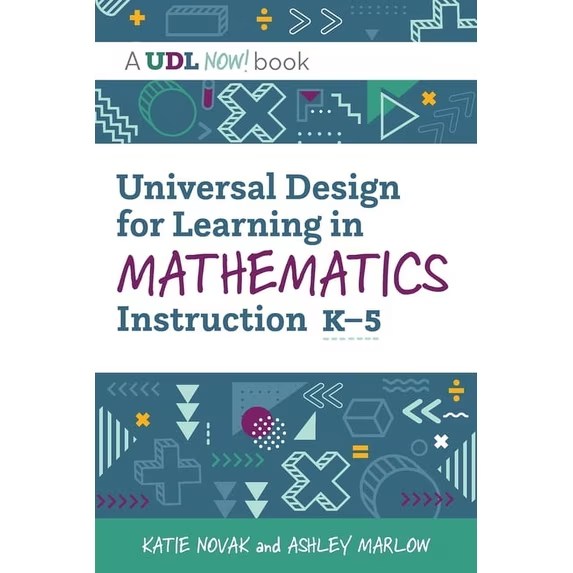
How can we break down barriers in elementary math and design instruction where every student thrives? In this episode of Math: Universally Speaking, host Ron Martiello sits down with Ashley Marlow—elementary math coach, consultant, Director of Operations at All Learners Network, and co-author of Universal Design for Learning in Mathematics Instruction K–5.
Ashley shares her journey of connecting high-quality math pedagogy with Universal Design for Learning (UDL) and Multi-Tiered Systems of Supports (MTSS). Together, Ron and Ashley unpack:
- Dismantling Math Myths: Why we need to take math off its “pedestal” and shift from procedural drill to deep conceptual understanding.
- Proactive UDL vs. Reactive Differentiation: How anticipating learning barriers ahead of time creates accessible Tier 1 instruction for all students.
- High-Leverage Concepts (HLCs): Prioritizing foundational through-lines (place value, number sense, fractional reasoning) over short-term “whack-a-mole” interventions.
- Building Learner Agency: Empowering students to make choices, develop voice, and take ownership of their mathematical thinking.
Whether you’re a K–5 classroom teacher, math coach, special educator, or administrator, this episode provides actionable strategies to foster true inclusion and learner agency in your math classroom.
Show Notes
Ashley Marlow is an elementary math coach, a consultant, and the director of operations for All Learners Network. She has 15 years of experience in teaching and coaching and is passionate about supporting teachers in creating equitable learning opportunities in math. She is the co-author of Universal Design for Learning in Mathematics Instruction, K-5. Ashley plans professional learning opportunities focusing on instructional routines in mathematics that support belonging and engagement.
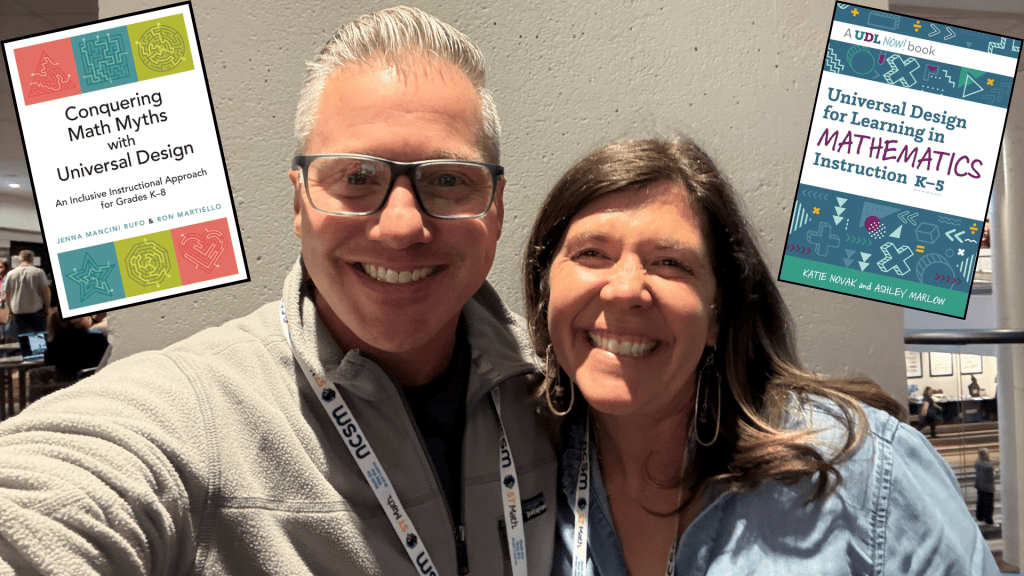
Selfie at the Annual NCSM Conference 2025 in Atlanta
Transcript
This transcript has been lightly edited and curated for clarity, readability, and flow, and is not a strict verbatim account.
Unlocking Inclusive Math: Combining UDL and Elementary Instruction with Ashley Marlow
Ashley Marlow is an elementary math coach, a consultant, and the Director of Operations at All Learners Network. She has 15 years of experience in teaching and coaching and is deeply passionate about supporting teachers in creating equitable learning opportunities in mathematics. She also co-authored a book with Katie Novak titled Universal Design for Learning in Mathematics Instruction K–5.
I’m very excited to share this conversation with you as Ashley and I discuss how we’ve discovered ways to find the intersections between great mathematics instruction and Universal Design for Learning (UDL)—making them seamless and empowering our students to be great doers of math. Enjoy!
Section 1: Background & Finding the Intersection of Math and UDL
Ron Martiello: Thank you so much for being on the podcast, Ashley. This interview has been a couple of months in the making because I’ve been so eager to reconnect with you since seeing you in Atlanta at the NCSM conference, where I caught your presentation on the book. Tell us a little bit about yourself, your background, and how you started making connections between math and Universal Design for Learning.
Ashley Marlow: Yeah, I would love to share that. First of all, thanks for having me, Ron. It’s always great to connect with folks doing similar work who are committed to supporting teachers and helping more students access high-quality learning opportunities. I think that’s what we both connected on.
That is actually exactly how I got started in this work. I spent most of my career as a third-grade teacher and earned my master’s degree in teaching elementary mathematics. I became a math coach and started doing professional development part-time with my current company, All Learners Network, while still coaching and teaching. In 2022, I came on full-time as Director of Operations. Now, I spend my time working with classroom teachers, special educators, and instructional coaches, thinking about how to design math learning opportunities that promote true inclusion for all students.
Along the way—I live in Vermont—our state passed legislation called Act 173. One of its main tenets was a strong recommendation to support teachers in using Universal Design for Learning as part of a Multi-Tiered System of Supports (MTSS). Vermont is a full-inclusion state, so the goal was clear: if we want to meaningfully include all students in Tier 1 settings, we have to make intentional instructional design choices.
During that initiative, I met Katie Novak, who was serving as our facilitator. We met at a conference, and we like to joke that it was a bit of a “meet cute” at the lunch table. She was talking about her work in UDL, and I was sharing my work in math education. She said, “I hear all the time that we can’t use the UDL framework in math—that math is its own separate subject. I don’t have math expertise, so I struggle with buy-in when I talk to math educators.”
I replied, “Well, I’m deeply interested in UDL, I’ve applied these principles, and I do have the math expertise.”
We decided to collaborate. We wrote an article together, and then CAST invited us to co-author the book. It was a true blending of our backgrounds, demonstrating that there are profound intersections between UDL research and high-quality math pedagogy—and providing practical ways to apply those ideas in the classroom.
Section 2: Dismantling the “Math on a Pedestals” Myth
Ron Martiello: Isn’t it funny how people put math on a pedestal? They set it up high like, “Well, it’s math—it doesn’t really connect anywhere else. It’s rigid and logical.” And people like keeping it up on that pedestal!
Ashley Marlow: Yes! In math education, we are having to undo a lot compared to literacy education, and there has been a massive shift in practice in a relatively short time.
Think about the way most of us learned mathematics: it was procedural, one-size-fits-all, and driven by the idea that there is only one right way to solve a problem. Shifting that pedagogy means asking teachers to teach in a way they never experienced as students. On top of that, elementary teacher preparation programs historically place a much heavier emphasis on literacy than mathematics.
Putting math on a pedestal often comes out of self-preservation. When you’re asked to teach in a way you’ve never experienced or been trained for, that reaction is natural. My hope is to help chip away at that anxiety for teachers by providing them with opportunities to experience math well so they can teach it well.
Ron Martiello: I’ll tell you what—earlier in my career, when I was first approached about becoming a math coach, I thought, “Nah, that’s not my thing.” At the time, it was tagged onto a technology coach role as an extra responsibility.
But once I dove in and began examining the Common Core State Standards—how they build conceptual understanding, procedural fluency, and real-world problem-solving, along with the incredible coherence from topic to topic across grade levels—I was fascinated. When I was trained in UDL, I immediately saw those same intersections. Listening to you speak at NCSM back in October, I was smiling ear to ear thinking, “She is in my head—we are thinking the exact same things!”
Section 3: Multi-Layered Systems of Support & High-Leverage Math
Ron Martiello: Speaking of big shifts, what is the hottest topic or biggest debate you’re finding in math education right now?
Ashley Marlow: Right now, I am spending most of my time talking about math intervention.
If we think about an effective system using MTSS, I actually prefer the term Multi-Layered System of Supports. The visual of “layers” helps us reframe the work. “Tiers” can make people think about putting kids into isolated buckets or labeling them permanently, which was a flaw when MTSS grew out of traditional RTI models.
A multi-layered understanding relies on Universal Design for Learning as our foundational layer. All students are included in that initial opportunity to engage in grade-level mathematics. That doesn’t mean everyone learns it at the same speed or shares the exact same goal at the exact same moment, but the lesson is designed so everyone can access and engage with the content.
What I’m spending a lot of time on now—which connects directly to UDL—is ensuring that supplemental layers of instruction (intervention and specially designed instruction) directly support access to that universally designed Tier 1 lesson. Meaningful intervention needs to elevate student understanding of high-leverage mathematics—those concepts with the strongest through-lines across grade levels.
Instead of running interventions focused strictly on short-term fact memorization, which has a notoriously short shelf-life (especially for students with working memory challenges), intervention needs to narrow its focus to critical conceptual foundations. If intervention builds high-impact skills—problem-solving, comparing strategies, and critical thinking—students are far more capable of stepping into the Tier 1 classroom and accessing grade-level content.
Ron Martiello: I love how you explain those through-lines—those high-leverage topics that cross grade levels, building deep mathematical reasoning rather than just helping kids pass a quick quiz. Can you elaborate on what those high-leverage concepts look like in practice?
Ashley Marlow: Absolutely. At All Learners Network, we spent years researching and working in schools to identify what we call the High-Leverage Concepts (HLCs). Katie and I highlighted these in the book across the core mathematical strands.
If you look at the progression of standards from Pre-K through Grade 6, you see this beautiful, interconnected progression.
Ron Martiello: It really is! That’s what fascinated me—this beautiful progression of standards, how they dance together and build upon one another.
Ashley Marlow: Exactly. Tier 1 provides access to grade-level standards, which move through peaks and valleys: early number sense, additive reasoning, multiplicative reasoning, fractional thinking, and proportional reasoning.
Our High-Leverage Concepts help teachers prioritize when writing IEP goals or designing intervention. We ask: What is the mathematics that, if missing, will exclude a student from accessing the majority of future grade-level math?
- In Kindergarten & 1st Grade: It’s counting forward/backward, recognizing quantities to 20, and composing and decomposing numbers. Without the ability to flexibly build and break apart numbers, students will struggle in 1st and 2nd grade with addition and subtraction strategies, place value, and operating with multi-digit numbers.
- In Intermediate Grades: Place value understanding directly drives multiplication and division of multi-digit numbers. When students reach fractions, composition and decomposition return. If a 5th grader can’t compose and decompose unit fractions, their only remaining fallback is memorized, meaningless procedures.
When I coach interventionists and special educators, I encourage them: if you teach 3rd grade, don’t change your intervention focus every two weeks to match a minor topic like telling time. Instead, prioritize place value and additive/multiplicative structures. Those yield the highest return on investment across every unit.
It stops teachers from feeling like they’re playing a perpetual game of “whack-a-mole”—trying to fix every isolated gap reactively. UDL and targeted HLC interventions allow us to focus our precious energy on what unlocks grade-level learning.
Section 4: Proactive Design vs. Reactive Differentiation
Ron Martiello: That is such a vital point. I often see teachers want to spend extended time on minor units like telling time or counting money because they feel like “life skills,” but they miss those structural high-leverage topics like place value, fractions, and spatial reasoning. Making use of mathematical structure is such an underrated practice!
You also touched on proactive design versus reactive deficits. How can we coach school teams to shift away from traditional, reactive differentiation toward a proactive UDL mindset?
Ashley Marlow: That distinction is critical because people often confuse UDL with differentiation. Both are valuable, but they operate differently:
- Universal Design for Learning (Proactive): You anticipate the barrier and design options for human variability before the lesson begins.
- Differentiation (Reactive): You adapt or modify instruction on the fly after noticing that a student is struggling during the lesson.
For example, suppose the mathematical goal of a lesson is for students to explore equal groups in multiplication and observe how increasing the factor changes the product.
- A reactive approach might introduce the task to the whole class, notice three students struggling to read the word problem, and pull them to a back table to read it aloud to them.
- A UDL approach identifies reading as a potential barrier ahead of time. Recognizing that the lesson goal is mathematical reasoning about scale and multiplication, not decoding text, the teacher reads the problem aloud to the entire class, models a 3-Reads strategy, and invites initial visual representations before independent work.
By removing the reading barrier universally, every student benefits. Students with reading challenges get immediate access, and students who read quickly are encouraged to slow down, make sense of the context, and think deeply rather than just grabbing numbers to calculate.
Ron Martiello: Exactly! It helps those “fast calculators” who instinctively pluck numbers out without making sense of the problem. Slowing them down through a shared read forces them to make sense of the mathematics before calculating.
Ashley Marlow: Absolutely. Speed is not the mark of a great mathematician. Real mathematical breakthroughs take time and deep reflection.
When we design from the margins for all students, we shift the entire culture of the classroom. We move from a teacher-centered model—where the teacher is the source of all answers—to a student-centered model, where the teacher facilitates opportunities for students to construct meaning, analyze multiple perspectives, and become genuine doers of mathematics.
Section 5: Coaching Analogy, Voice & Choice, and Competence Assumptions
Ron Martiello: You send the message that a student’s job here is to think, not to simply regurgitate everything the teacher does.
I think about coaching—I’ve coached a lot of youth sports over the years with my own kids, and practice coaching vs. game coaching are very different. During practice, I help them through specific situations and identify trends. But during a game, I have to provide feedback on big ideas so kids have room to read and react to different situations on their own.
I see coaches on the field yelling micro-instructions constantly to every player, but instead, it should be: “Keep the ball in the middle of the field,” “Use the sideline,” or “Spread out and support one another.” Those big ideas give kids room to maneuver no matter what challenge they face.
Math is the exact same way. Let’s provide big ideas and give kids room to think rather than forcing them to mimic a single method. Sometimes, well-intentioned educators try to limit what kids have to think about, almost trying to remove the struggle entirely. But let’s not take the thinking away—let’s expand on that thinking!
Ashley Marlow: Two big things come to mind hearing that analogy:
- Choice-Making: Voice and choice are foundational UDL elements. Developing the habits and self-awareness to make good choices as a learner is deeply empowering. It shifts power away from the teacher declaring, “I decided you need this problem read aloud,” or “I decided you must use this manipulative.” UDL teaches students how to make effective choices for themselves rather than making choices on their behalf.
- Assuming Competence: I work with amazing educators and students with complex, exceptional disabilities, ages 16 to 21. Traditionally, their math goals focused strictly on functional life skills. We began shifting to real mathematical goals rooted in the least dangerous assumption—assuming that far more thinking and communicating is happening than we might initially realize.
Instead of assuming a student can’t do something, we assume: “This student can count; I just haven’t figured out how to understand their communication yet.”
By changing our tools and creating new ways for students to show their thinking, these students are making monumental gains—composing/decomposing within 5 and counting to 10. Shifting your mindset to assume your students are capable feels incredible.
Ron Martiello: Absolutely. Nobody enters education wanting students to be incapable. But our traditional systems can make it difficult to appreciate non-traditional styles of communication and thinking.
Ashley Marlow: Exactly. UDL forced me to think outside the box. If my goal is firm and I believe in my students’ capacity, my responsibility is to design an environment where I can understand their thinking better. The shift is moving from “I need students to complete this task” to “I need to build an environment where I can understand what my students know and can do.”
Ron Martiello: That is the difference between focusing solely on the final answer versus investing in the space between the problem and the solution. Traditional instruction often asks questions that guide kids to a single answer, whereas UDL asks questions that illuminate their reasoning.
Section 6: Learner Agency & The Purpose of UDL 3.0
Ron Martiello: UDL isn’t a brand-new framework—it originated back in 1998 out of special education and assistive technology before expanding to general pedagogy. With updates like UDL 3.0, the ultimate goal has shifted from teacher-driven design toward true learner agency.
Ashley Marlow: Yes! Learner agency is about students understanding who they are as learners, knowing what environment helps them thrive, and feeling empowered to navigate their own learning trajectory.
Ron Martiello: We can get lost in the framework’s mechanics, but building reflective, action-oriented, and purposeful learners is the true goal. Historically, when did we ever talk about students feeling empowered in math?
Ashley Marlow: Exactly. I sometimes hear people use “UDL” as a verb, like, “I’m UDLing my lesson.”
I love having conversations about that phrase because UDL isn’t a checklist, a prescription, or a formula. It is a decision-making framework for proactive, inclusive design. And you can’t “UDL” a lesson if half the students are pulled out of the room for core instruction! UDL is a tool in your toolbox to guide your pedagogical mindset for the real human beings in front of you.
Closing Remarks & Contact Information
Ron Martiello: As we wrap up today’s conversation—and I could talk to you all day about this—what is a final message you’d like to leave with our listeners as they leverage UDL in their math classrooms?
Ashley Marlow: My message is the same one I give myself every day: How can I find more opportunities to listen than to talk?
The more we listen to our students—through surveys, interviews, and observations—the better we can build learning environments that honor their full humanity. Rather than telling educators what they “should” do, I want us to listen to teacher and student experiences so we can collaboratively build more inclusive classrooms.
Ron Martiello: Thank you so much, Ashley. I have thoroughly enjoyed our conversation. I strongly encourage our listeners to check out Ashley’s work at All Learners Network. Ashley, where can people find you?
Ashley Marlow:
- Website: Visit alllearnersnetwork.com to explore our resources and sign up for our free monthly one-hour webinars hosted by my colleagues and me.
- LinkedIn: Connect with me directly—I regularly respond to messages!
- Email: You can reach out through the contact form on the All Learners Network website. I would love to hear your stories, successes, and challenges!
Ron Martiello: Thank you, Ashley, and thank you to our listeners for tuning in. I hope this episode provided actionable insights on connecting Universal Design for Learning with mathematics instruction to empower your students as deep thinkers.
Professional Development Questions
- Proactive vs. Reactive Design
- In the episode, Ashley and Ron discuss the key difference between proactive UDL design (anticipating barriers like reading comprehension before a lesson starts and addressing them universally) and reactive differentiation (modifying instruction on the fly after a student struggles).
- Reflective Question: Looking at an upcoming math unit, what is one common non-mathematical barrier (e.g., heavy text reading, working memory demands, fine motor tasks) that might prevent students from accessing the core goal? How can we proactively design a scaffold into Tier 1 instruction so all students benefit without taking away the mathematical thinking?
- In the episode, Ashley and Ron discuss the key difference between proactive UDL design (anticipating barriers like reading comprehension before a lesson starts and addressing them universally) and reactive differentiation (modifying instruction on the fly after a student struggles).
- High-Leverage Concepts vs. The “Whack-a-Mole” Approach
- Ashley highlights how intervention time is often wasted on short-term memorization or minor topics (like telling time) rather than High-Leverage Concepts (HLCs) like place value, composition/decomposition of numbers, and fractional reasoning that serve as critical through-lines across grade levels.
- Reflective Question: When we evaluate our current supplemental/intervention supports (Tier 2/3), are we spending energy reactively chasing minor unit topics (“whack-a-mole”), or are we prioritizing foundational concepts that unlock grade-level standards? What is one High-Leverage Concept in our grade level that yields the highest return on investment for student access?
- Ashley highlights how intervention time is often wasted on short-term memorization or minor topics (like telling time) rather than High-Leverage Concepts (HLCs) like place value, composition/decomposition of numbers, and fractional reasoning that serve as critical through-lines across grade levels.
- Promoting Learner Agency & Assuming Competence
- A central takeaway from the episode is shifting the role of the teacher from the “giver of answers” to a facilitator who builds learner agency and operates under the least dangerous assumption—believing all students are capable of deep mathematical reasoning when given the right tools and choices.
- Reflective Question: What opportunities do our students currently have to exercise genuine “voice and choice” in how they process and demonstrate their math thinking (e.g., choice of representations, strategies, or manipulatives)? How can we shift our classroom questioning strategies away from guiding kids to a single quick answer and toward illuminating their actual reasoning?
- A central takeaway from the episode is shifting the role of the teacher from the “giver of answers” to a facilitator who builds learner agency and operates under the least dangerous assumption—believing all students are capable of deep mathematical reasoning when given the right tools and choices.
References
APA (7th ed.) Novak, K., & Marlow, A. (2024). Universal design for learning in mathematics instruction, K–5. CAST Professional Publishing.
Google. (2026). Gemini (Large language model). Assisted in transcribing, formatting, and generating episode summary and professional development materials.https://gemini.google.com


Leave a Reply