Listen on your favorite platform.




Description
Whether your classroom is energized like Earth, Wind & Fire’s “September” or feeling the back-to-school fatigue of Green Day’s “Wake Me Up When September Ends,” strong connections are key to a successful school year.
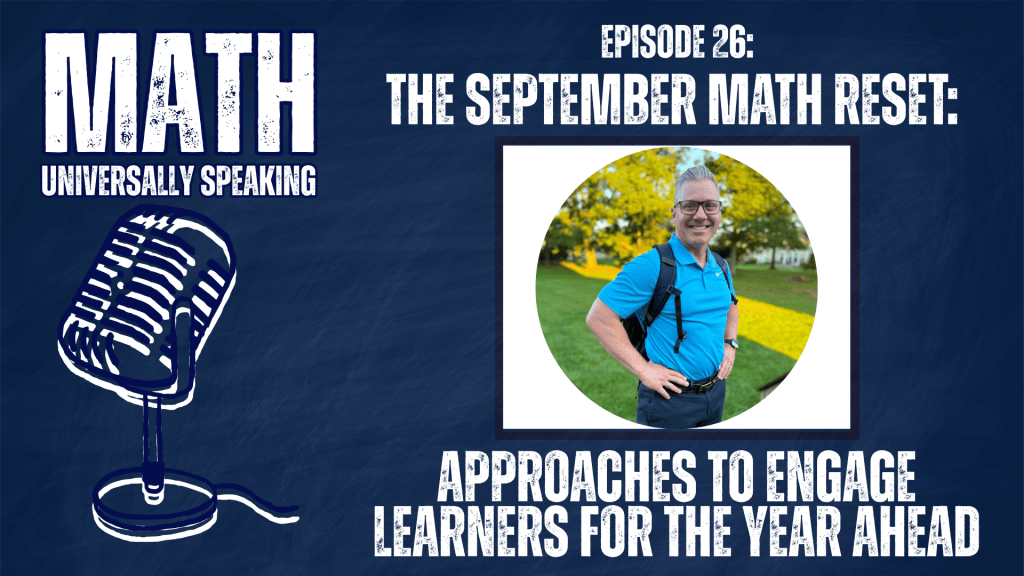
In this episode of Math: Universally Speaking, we explore three practical Universal Design for Learning (UDL) approaches to build community, support diverse learners, and engage students from day one:
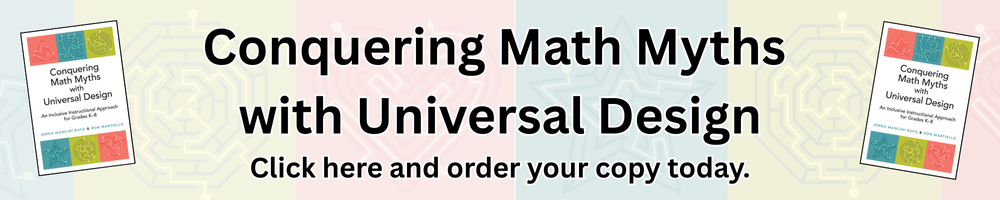
- Reflecting on Math Identity: Empowering students through math biographies, songs, or art (Conquering Math Myths with Universal Design).
- Instructional Triads: Using John SanGiovanni’s small-group framework to lower performance anxiety and support language learners.
- Modern Mathematicians: Showcasing inspiring real-world figures like John Urschel, Gladys West, and Lonnie Johnson so every student sees themselves in math.
Learn how to cultivate agency, foster peer collaboration, and build an inclusive math environment from the start!
Show Notes
Modern Day Mathematicians
1. José M. Hernández (1962–Present)
- Identity: Mexican American engineer, former NASA astronaut, author, and vineyard owner.
- Daily Student Connection: Digital camera sensors, agricultural technology, and space shuttle missions.
- How Math Impacts Their Life: The son of migrant farmworkers who didn’t learn English until age 12, Hernández co-developed the first full-field digital mammography imaging system at Lawrence Livermore National Laboratory, using digital signal processing math to detect early-stage breast cancer. Later, as a NASA flight engineer on STS-128, he used orbital mechanics and trajectory calculations to assist in flying the Space Shuttle Discovery to the International Space Station.
- Middle School Hook: “A migrant farmworker who didn’t speak English until age 12 used high-level engineering math to travel into space.”
- Additional Fact: His life inspired the movie A million Miles Away.
2. John Urschel (1991–Present)
- Identity: African American mathematician, author, and former NFL offensive lineman.
- Daily Student Connection: Sports analytics, video game AI, and machine learning.
- How Math Impacts Their Life: Urschel played three seasons in the NFL for the Baltimore Ravens while simultaneously completing his Ph.D. in mathematics at MIT (where he is now an assistant professor). He uses graph theory and linear algebra to analyze massive networks, build AI pathfinding for games, and calculate advanced sports metrics.
- Middle School Hook: “He blocked 300-pound NFL defensive linemen on Sundays and solved MIT math proofs on Mondays.”
3. Katherine Johnson (1918–2020)
- Identity: African American mathematician, physicist, and space pioneer.
- Daily Student Connection: Space exploration, satellite imagery, and emergency landing systems.
- How Math Impacts Their Life: Long before electronic supercomputers were reliable, NASA relied on human “computers.” When astronaut John Glenn was scheduled to orbit the Earth, he famously refused to launch until Katherine hand-verified the complex geometric differential equations generated by early computers. Her math calculated launch windows and return trajectories for the Apollo moon missions.
- Middle School Hook: “An astronaut refused to blast off into space until she personally checked the supercomputer’s math by hand.”
4. Gladys West (1930–Present)
- Identity: African American mathematician and computing pioneer.
- Daily Student Connection: GPS, Google/Apple Maps, Snapchat geotags, and rideshare navigation.
- How Math Impacts Their Life: Every time a student drops a location pin, tracks a school bus, or uses digital navigation, they rely on West’s work. In the 1970s and 80s, she programmed complex algorithms to model the exact physical shape of the Earth (an irregular ellipsoid). Without her geodetic calculations, modern GPS systems couldn’t accurately pinpoint where you are on the planet.
- Middle School Hook: “Your phone doesn’t just guess where you are on Snapchat or Google Maps—it relies on her satellite math.”
5. Stephen Hawking (1942–2018)
- Identity: British theoretical physicist, mathematician, and disability rights icon (diagnosed with ALS at age 21).
- Daily Student Connection: Sci-fi movies, space exploration, and smartphone accessibility features.
- How Math Impacts Their Life: Hawking held the Lucasian Professorship of Mathematics at Cambridge. Unable to write equations on paper for most of his career, he trained his mind to visualize complex mathematical geometry and 4D shapes entirely in his head. The eye-tracking and cheek-switch technology engineered for his speech synthesizer helped pioneer accessibility features used on mobile devices today.
- Middle School Hook: “He couldn’t hold a pencil, so he solved complex equations about the 4D universe entirely inside his head.”
6. Maryam Mirzakhani (1977–2017)
- Identity: Iranian mathematician; first woman to win the Fields Medal (the highest honor in mathematics).
- Daily Student Connection: 3D CGI animation, video game graphics, and physics engines.
- How Math Impacts Their Life: Mirzakhani spread giant rolls of white paper across her living room floor, drawing complex geometric surfaces to solve theoretical math problems. Her research on non-Euclidean surfaces helps computer graphics engineers model how curved 3D shapes warp, bend, and collide—the exact geometry used to make character movement and world graphics look realistic in modern animated films and open-world video games.
- Middle School Hook: “She drew ‘math doodles’ on giant rolls of paper on the floor—unlocking geometry that makes 3D video game characters move.”
7. Lonnie Johnson (1949–Present)
- Identity: African American nuclear engineer, NASA inventor, and entrepreneur.
- Daily Student Connection: Super Soakers, Nerf blasters, and electric vehicle batteries.
- How Math Impacts Their Life: While working as a systems engineer at NASA’s Jet Propulsion Laboratory, Johnson applied fluid dynamics—the math of how liquids and gases move under pressure—to invent the Super Soaker and high-pressure Nerf blasters. Today, he uses thermodynamic math and material science to build next-generation solid-state batteries for green energy and electric vehicles.
- Middle School Hook: “The world’s most famous high-pressure water gun was built by a NASA scientist using fluid dynamics math.”
Transcript
The September Math Reset: Approaches to Engage Learners for the Year Ahead
Welcome back, everyone. September is officially here.
When you think about September, two starkly different songs come to mind.
On one hand, you’ve got Earth, Wind & Fire’s “September.” It represents that high-energy, joyful celebration, ready-to-go feeling.
On the other hand, you’ve got Green Day’s “Wake Me Up When September Ends,” which speaks to wanting to avoid September, feeling overwhelmed, and wanting to hit fast-forward until the initial chaos passes.
Some are ready to rock out like Earth, Wind & Fire, while others are trying to avoid the pressure like in Green Day’s interpretation. Our students walk into our classrooms with a full spectrum of feelings between these two margins. So how might we bridge this gap? Perhaps the answer lies in exploring the power of connections.
As students enter this new math community, let’s consider how we might invite them into these essential connections: to their own math identities, to one another, and to diverse mathematicians.
Here are three specific approaches to make those connections.
The first approach is helping students reflect on their own mathematical identity and learning preferences.
This means tapping into how they feel about math, tapping into what they feel their strengths are as far as math content, and asking key questions like:
- “What areas of math do you feel you know really well?”
- “How do you learn math best?”
- “What has been the best way for you to learn math?”
Asking these questions allows teachers to not just understand their students’ perspectives, but to also use that information to plan steps forward to help these students.
One concrete way teachers can do this—as Dr. Rufo and I talk about in Conquering Math Myths with Universal Design—is by giving students autonomy in how they communicate their math identity. At this point, math is deeply personal to them, and they need to feel comfortable in how they present that to you and their classmates.
Instead of a standard one-size-fits-all reflection, offer multiple ways to show their identity:
- Writing a math biography
- Composing a song
- Drawing a picture
- Choosing another creative medium that fits them
By providing choice and autonomy in how they communicate, we get better responses and can dive much deeper. It allows students to express themselves better as they reflect on their prior knowledge, content strengths, and their strengths regarding how they learn math best.
The second approach is connecting students to one another in the classroom to establish community through instructional triads—a strategy I learned from John SanGiovanni at an NCTM conference.
Having a group of three is the perfect number so that you have at least two people talking about the math at a time while giving someone a chance to listen. In a traditional pair, both people are always “on stage” and talking back and forth. If one person is having difficulty making those connections, communicating their math, or comprehending the math, that is a lot of pressure to put on the other partner. A triad provides that space students can actively discuss their math or observe for a little bit before engaging.
This changes the environment to meet the diverse needs of our learners. Whether they are excited about their work and want to share it or they need to sit and watch the math before starting their work, students can move fluidly within the triad as an observer or communicator.
When implementing triads, keep these key practices in mind:
- Coach active participants: We must coach whoever is active in the conversation to always seek ways to connect that third person and ensure they are included.
- Be intentional with setup: You don’t always need to set up groups where someone struggling with math is paired with two people who aren’t, but you need to choose wisely as far as how you develop those triads.
- Treat them as a math support group: Think of this as their daily math support group where they work together, work independently, make mistakes, and observe math conversations.
- Rotate regularly: You can change up the triads whenever you need to, and changing them regularly gives students different perspectives.
The third approach is presenting students with people who are actually doing the work in mathematics and leveraging it to impact things students see in their everyday lives.
When looking at math curriculum, sometimes math is presented as just numbers and problem-solving. But to truly connect students, they need to see themselves in the math.
By presenting individuals who have made a significant impact in their fields using math over the past 50 or 60 years, we give students a better chance of seeing themselves in the work. We want them to see themselves as people who can contribute to the future of science and technology and impact people’s everyday lives.
To keep things short today, I want to highlight three specific individuals who may help to hook your students.
- John Urschel: An NFL player for the Baltimore Ravens who used math to excel at the highest athletic level while ultimately pursuing his passion to become a professor of mathematics at MIT.
- Gladys West: A mathematician whose complex mathematical modeling of the earth was foundational to developing the modern satellite GPS technology we use every single day.
- Lonnie Johnson: A mechanical engineer who applied fluid dynamics and mathematical principles to invent the iconic Super Soaker for Nerf.
When we continually put people like John Urschel, Gladys West, and Lonnie Johnson in front of our students, we show them what it looks like to excel in their field through mathematics—and help them see that they can do the same. You can find a longer list in the show notes, and I would love for you to share any other mathematicians you like to highlight for your students.
Whether students are ready to go with Earth, Wind & Fire or feeling like Green Day, these three approaches—reflecting on their math identity through autonomous options, connecting them to peers through instructional triads, and connecting them to modern mathematicians—help students establish their math identities in your new math community this September.
Be sure to check out the show notes for the extended list of mathematicians to share with your class. Thanks for listening.
Take care.
Professional Development Questions
- How can you provide students with more choice in how they demonstrate their mathematical understanding or reflect on their identity?
- How can you structure and coach “active participants” in small group math conversations to ensure all students are included, especially those who prefer to observe before engaging?
- How can you more intentionally and consistently integrate diverse, modern real-world role models into your instruction to make mathematics more relatable and inclusive?
References
Hernández, J. M. (2012). Reaching for the stars: The inspiring story of a migrant farmworker who became an astronaut. Center Street.
National Aeronautics and Space Administration. (2019, August 7). Katherine Johnson biography. NASA History. https://www.nasa.gov/content/katherine-johnson-biography
National Inventors Hall of Fame. (2022). Inductee Lonnie Johnson: Super Soaker. https://www.invent.org/inductees/lonnie-johnson
Royal Society. (n.d.). Stephen Hawking: Fellow detail. The Royal Society. https://royalsociety.org/people/stephen-hawking-11589/
Stanford University. (2017, July 15). Maryam Mirzakhani, Stanford mathematician and Fields Medalist, dies at 40. Stanford News. https://news.stanford.edu/2017/07/15/maryam-mirzakhani-stanford-mathematician-fields-medalist-dies-40/
United States Air Force Space Command. (2018, December 6). Dr. Gladys West inducted into Space and Missile Pioneers Hall of Fame. Air Force Space Command News. https://www.afspc.af.mil/News/Article-Display/Article/1707464/dr-gladys-west-inducted-into-space-and-missile-pioneers-hall-of-fame/
Urschel, J., & Scelfo, J. (2019). Mind and matter: A life in math and football. Penguin Press.


Leave a comment