Listen on your favorite platform.




Description
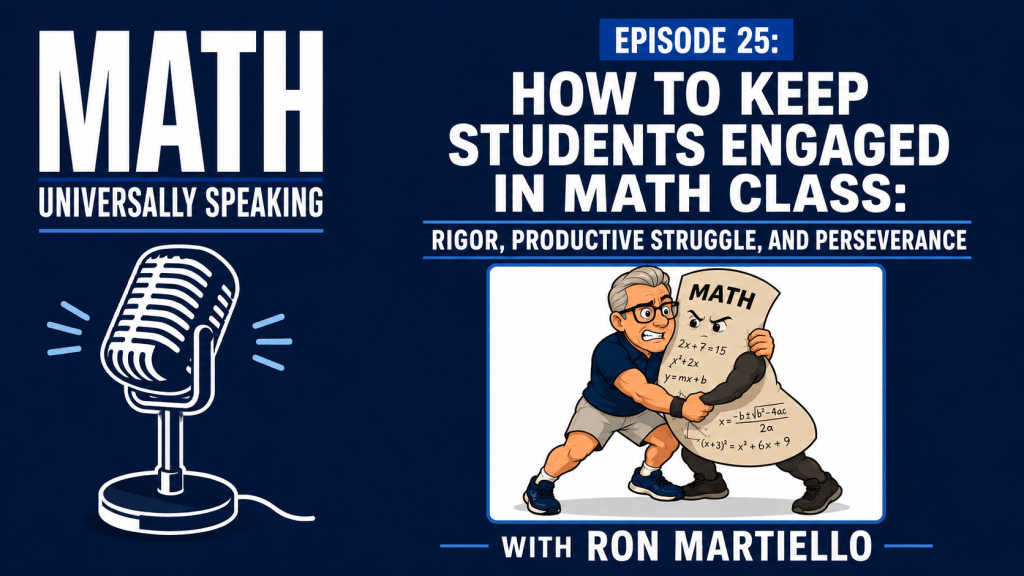
How to Keep Students Engaged in Math Class: Rigor, Productive Struggle, and Perseverance
In this episode of Math: Universally Speaking, Ron Martiello explores how educators can keep students engaged during math learning by intentionally designing for rigor, productive struggle, and perseverance through the lens of Universal Design for Learning (UDL).
Ron clarifies the differences between three commonly misunderstood mathematics education terms—rigor, productive struggle, and perseverance—and explains why understanding these distinctions matters when designing equitable, inclusive, and engaging math instruction.
Throughout the episode, listeners will discover practical ways to sustain student effort and persistence in mathematics, including:
- Clarifying learning goals
- Optimizing challenge and support
- Using scaffolds during problem solving
- Fostering collaboration and mathematical discourse
- Building belonging and community in math class
- Providing actionable feedback that advances student thinking
Ron also discusses how teachers can support students without taking away the thinking, why struggle is an important part of learning mathematics, and how classroom design can help students see themselves as capable mathematicians.
This episode is valuable for K–12 teachers, instructional coaches, interventionists, special educators, administrators, and school leaders looking to strengthen student engagement in mathematics through inclusive and rigorous instructional design.
Whether you teach elementary, middle, or high school mathematics, this conversation will provide practical ideas for helping students sustain effort, persist through challenges, and build deeper mathematical understanding.
Listen to Math: Universally Speaking on Apple Podcasts, Spotify, Amazon Music, Castbox, or your favorite podcast platform.
Show Notes
Listen to these related episodes.
Transcript
How to Keep Students Engaged in Math Class: Rigor, Productive Struggle, and Perseverance
Hello, friends. This is Ron Martiello, and welcome back to Math: Universally Speaking. Thank you so much for being here and for continuing to support this passion project of mine. Everything we do here is grounded in one core belief: math is for all, and math is for life.
We want every student to feel included in mathematics and to see it not as a gatekeeper, but as an accelerator—something that opens doors and helps them move toward whatever goals they have for their future.
Today, we’re continuing our conversation around multiple means of engagement. In an earlier episode, we talked about welcoming identities and interests—how students see themselves in math and how that impacts access. Today, we’re shifting into another critical part of the framework: how we engage students during learning so they can sustain effort and persist in mathematics.
And let’s be honest—this is hard work. Every day, teachers are trying to reach a wide range of learners, all with different needs, experiences, and levels of confidence. Keeping students engaged in math class is not easy, especially when some students feel like observers instead of participants, or worse, like they don’t belong in the work at all.
So today, I want to focus on how we can intentionally design for engagement in mathematics during learning by clarifying the meaning of a few math terms we use everyday and their connections to Universal Design for Learning.
Part 1: Rigor and Clarifying Goals
So our first term is the word Rigor.
When we talk about rigor, we’re not talking about making math harder. Rigor is about balance and depth. It’s the balanced pursuit of:
- Conceptual understanding
- Procedural skills
- Real-world problem solving and application
All three matter, and they need to work together.
Many of us learned math in a way that over-emphasized procedures—repeat the steps, get the answer. There wasn’t always a strong focus on understanding why these procedures worked or applying math in meaningful ways. So when we design rigorous experiences today, we’re doing something different than what we experienced in math class. We’re building connections across those three areas so students can understand the math deeply and transfer their learning as the math gets more complex.
Rigor is not about overwhelming students. If students are trying to escape the task—to sharpen 20 pencils or use the restroom 5 times—that’s not rigor. That’s a signal that something might be off in our approach.
So what does this mean for design?
Clarifying Goals
Students need to know what they are working toward.
Are we focusing on understanding? A procedure? Application? or a combination of the three?
We can’t assume students know the goal—we have to make it visible.
That means:
- Stating the goal at the beginning
- Revisiting it during the lesson
- Coming back to it at the end
Can we post the goal in the classroom and bring attention to throughout the lesson? And even more importantly, can students articulate it even if it is in their own words?
Because when students understand the goal, they focus on the process that will continue to serve them in future —not just getting answers in the moment.
Part 2: Productive Struggle
Now let’s move into our second term and connect it to several design moves that help students stay engaged.
Productive Struggle.
This is about design.
Productive struggle is the environment we create where students can wrestle with mathematics. Struggle is not a sign of weakness. When we keep it productive, it can make our students reasoning stronger. It’s that “bumpy road” that Kevin Dykema spoke to us about last season. And yes, it can be uncomfortable—for students and for us as teachers.
But here’s the key: we’re not throwing students into struggle without support. We’re anticipating barriers. We’re preparing for where students might get stuck.
If the work is too easy, students disengage. If it’s too hard, they disengage. But if we hit that “just right” space—where the task is accessible and still challenging—that’s where engagement happens.
Our role is to support students without taking the thinking away from them. In one of my presentations, I loved when I heard a teacher say don’t outsource the bumpy road by retreating to “easier math”. She was right! Don’t rescue students from their thinking—let’s help them to keep moving forward. Productive struggle is part of that process.
So how do we design for that?
Optimizing Challenge and Support
We want tasks that are challenging—but we also need to provide support when needed.
One way to do this is through scaffolding.
I once saw John SanGiovanni at an NCTM conference and he shared ways to scaffold problems for students who may not be able to access the problem because they had trouble reading it. He said if reading is a barrier in word problems, let’s keep the context consistent:
- Same story, different numbers
- Same story, different situation
- Same story, different unknown
This is just one way we can scaffold problems so we can reduce unnecessary complexity, and allow students to focus on the math goal.
We’re not lowering expectations—we’re removing barriers so students can stay engaged in the thinking.
Fostering Collaboration, Interdependence, and Collective Learning
Math is not meant to be done in isolation.
Students need opportunities to:
- Share strategies
- Compare thinking
- Talk through challenges
When collaboration is part of the culture of our classroom, it can make a big difference in how students approach math. Think, pair, shares, students working in triads, fishbowls, and gallery walks can all make a big difference in sustaining students effort in math class.
This way, when students get stuck, they don’t always need the teacher—they can learn from each other.
And over time, they begin to see collaboration as a natural part of doing mathematics.
Fostering Belonging and Community
Students need to feel like they are part of the math community.
That means positioning them as:
- Thinkers
- Problem solvers
- Authors of their ideas
It is important to showcase different students’ work, but they may not be willing to jump up in front of the class and share. We can still position them as math community members by providing them choices. Ask them:
- Do you want to present your math?
- Do you want to share your math with a partner?
- Can I help you share your math?
We’re supporting them while also honoring their ownership.
Because when students feel safe and valued, they’re more willing to engage in the math community.
Part 3: Perseverance and Actionable Feedback
Now let’s bring in our third term and connect it to how we respond to students during learning.
Perseverance.
This is about the student.
Perseverance is the behavior we’re trying to build. It’s not something students either have or don’t have—it’s something we help them develop.
When students encounter a barrier, do they have ways to move forward? That’s what we’re trying to coach.
This is where multiple strategies matter. Cathleen Beachboard recently reminded us of this when she spoke on the podcast. She told us that students can access “Will Power” if we help them work on their “Way Power”. If students only know one way to solve a problem and that way doesn’t work, they’re stuck. But if they have multiple pathways, they can keep going.
We’re helping students build both the will to persist and the ways to persist.
So how do we support that in the moment?
Providing Actionable Feedback
Feedback should move thinking forward.
Instead of focusing only on correct answers, we focus on the process:
- I noticed that you used a new strategy for this problem. Why did you use this one?
- I see this strategy worked for you in this problem. Do you think this strategy would work again in other problems? Come back and show me how on the next problem.
- I could see you got stuck half way through the problem. How did you change your thinking and how did that help?
This kind of feedback helps students reflect and refine their thinking.
It keeps them engaged in learning—not just finishing tasks.
Closing Thoughts
As we wrap up, I want to bring this all together.
If we want students to sustain effort and persist in math, we need to be intentional in how we design learning.
That starts with understanding:
- Understanding that rigor is a balanced pursuit of deeper mathematics
- How to design for productive struggle
- How to build perseverance in our students
And then we support that by:
- Clarifying goals
- Optimizing challenge and support
- Encouraging collaboration
- Building belonging
- Providing actionable feedback
I want to thank you for investing in this work. You are navigating this every single day with real challenges in real classrooms. I hope that this episode validates your hard work and gives you the courage to keep moving forward.
When we move this work forward—even in small ways—we create spaces where students stay engaged, persist through barriers, and become the capable mathematicians we know they can be.
And that’s the goal.
Because math should be an accelerator for their hopes and dreams—not a barrier.
Thank you so much for listening. I appreciate you being part of this journey, and I’ll see you next time. Take care.
Professional Development Questions
1. How do my instructional routines currently help students clearly understand learning goals, and what are some ways I can continue to strengthen that clarity to further support engagement and persistence in math?
2. Where am I already designing meaningful opportunities for productive struggle, and how can I build on those practices to better balance challenge and support so students remain actively engaged in mathematical thinking?
3. How do my feedback practices currently support students in developing perseverance, and what additional strategies could I use to further emphasize process, growth, and mathematical reasoning?
References
Beachboard, C. (2022). The school of hope: The journey from trauma and anxiety to achievement, happiness, and resilience. Corwin Press.
CAST. (2024). CAST Universal Design for Learning Guidelines version 3.0. https://udlguidelines.cast.org
Hicks, M. D., Bishop, J. P., Koehne, C., & Bui, M. (2023). Reconsidering mathematical authority. Mathematics Teacher: Learning and Teaching PK–12, 116(11), 826–836.
SanGiovanni, J. J. (2023). Daily routines to jump-start problem solving, grades K–8. Corwin.
SanGiovanni, J., Katt, S., Dykema, K. J., & Larson, M. (2020). Productive math struggle: A 6-point action plan for fostering perseverance. Corwin.


Leave a Reply