Listen on your favorite platform.




Description
Juli Dixon and The Fact Tactics Fluency Program
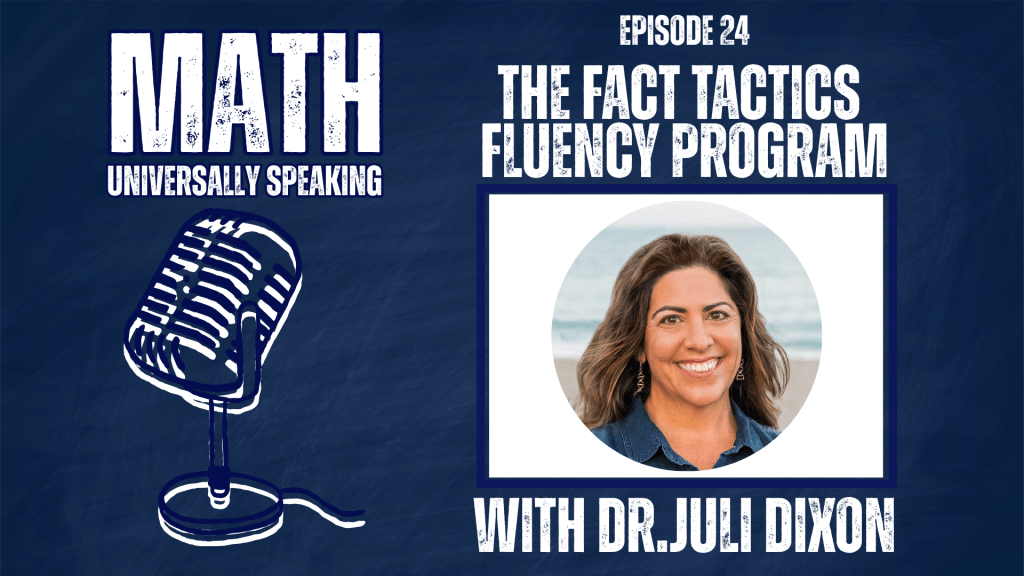
In this episode of Math: Universally Speaking, I am joined by Dr. Juli Dixon to discuss the framework behind The Fact Tactics Fluency Program. We explore how to move beyond rote memorization by focusing on the meaning of multiplication and the properties of operations. Juli explains how her program helps students transition from basic additive thinking to true multiplicative reasoning, ensuring they have a solid foundation for more advanced mathematics.
We take a deep dive into the six specific tactics that drive the program: Grounding, Linking, Strategic Repetition, Review, Assessment, and Extension. This episode isn’t just about theory—it’s about giving you high-impact strategies to build fluency while engaging students to take ownership of their own progress. Listen to the full episode now to discover Juli’s practical roadmap for transforming your approach to multiplication facts and challenging every learner in your classroom.
Follow Math Universally Speaking and join the conversation using #MathUniversallySpeaking.
Transcript
This transcript has been professionally edited for clarity and readability. It reflects the content and intent of the conversation but is not a verbatim, word-for-word record.
Juli Dixon and The Fact Tactics Fluency Program
Introduction
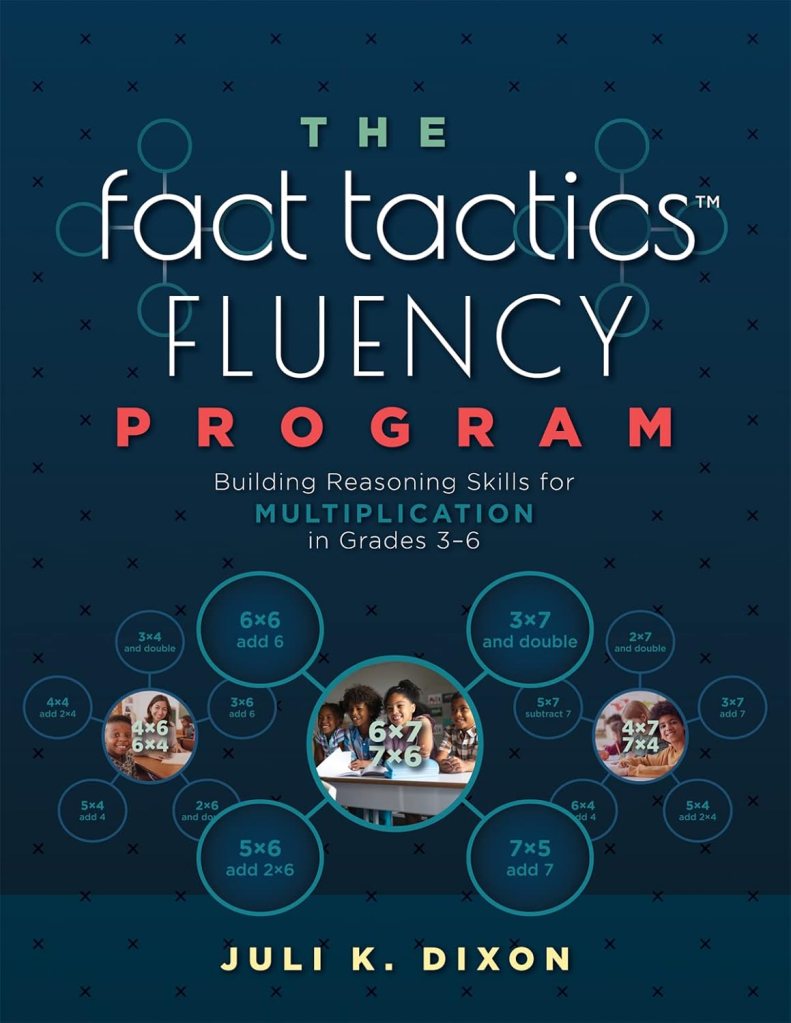
Ron: Hello, friends! This is Ron Martiello. Welcome back to math. Universally speaking, we have a fantastic guest today. She is the author of The Fact Tactics Fluency Program, a book you are definitely going to want to pick up. Dr. Julie Dixon, thank you so much for being here. Could you tell us a bit about your journey and how you got into this space?
Juli: Thank you, Ron. I’m a mathematics educator and recently retired from the University of Central Florida as Professor Emerita. I began as a classroom teacher and was careful to teach every grade level before becoming a professor so I could better prepare teachers for K-12 mathematics. My work focuses on professional development and making sense of mathematics to support every child’s learning.
The “Hottest Topic” in Math: Student Engagement
Ron: You’ve been in many educational spaces. Universally speaking, what would you say is the hottest topic in math right now?
Juli: Supporting student engagement. When I work with teachers across North America, the most common request is help with engagement. We are competing against so much as teachers right now. I believe we can elicit that engagement through meaningful mathematics instruction.
Ron: I agree. Many fluency programs promise results but rely on rote practice and computer programs that lack engagement. Your book seems to take a different approach.
Juli: Exactly. This 20-week program is designed to engage learners by connecting with where they are. It’s grounded in the meaning of multiplication and uses the properties of operations—like commutative and distributive properties—as tools for fluency rather than just notes for a test.
The Six Tactics of Fluency
Ron: You utilize six specific “tactics” in the program. Can you unpack those for us?
Juli: Certainly. These six tactics build the entire program:
- The Grounding Tactic: Everything is grounded in meaning. Once students understand the meaning of multiplication, they use multiplicative reasoning (using known facts to find unknown ones) rather than just skip counting or drawing.
- The Linking Tactic: We focus on the “remaining” 20 facts students need to learn (after accounting for 0s, 1s, 2s, 5s, and the commutative property). The order of these facts is specific to help students build on what they know.
- The Strategic Repetition Tactic: Students choose a strategy that makes sense to them and practice it throughout the week. They might even wear a lanyard with their “fact of the week” and their chosen strategy on the back to discuss with others.
- The Review Tactic: We move beyond flashcards to ask, “What was your strategy?” This reinforces the reasoning behind the product.
- The Assessment Tactic: We avoid timed tests. These are five-question mini-assessments where students identify the product and whether they “just knew it” or used a specific tactic.
- The Extension Tactic: For students who already know the grade-level facts, we provide challenges using the same properties. For example, if the fact is 6 x 7, an extension might be 2 x 134.
Teacher Implementation and Feedback
Ron: What are teachers saying about the program?
Juli: To be honest, they say the first two weeks are brutal! We are building a new routine and negotiating how to accept student strategies. But by week three, it becomes easy to implement, and teachers tell me the results make it completely worth it.
Ron: How does this fit into a teacher’s already crowded math block?
Juli: It’s about “lost minutes.” It might take 15–20 minutes to introduce a fact on Monday, but the rest of the week utilizes small windows of time—lining up for specials, morning announcements, or center rotations. It’s about centering mathematical reasoning in the daily routine.
Long-Term Impact and Closing Thoughts
Ron: What are the long-term benefits for students who master this fluency?
Juli: The National Mathematics Advisory Panel found that success in Algebra requires facility with computation and properties of operations. This program creates a “gateway” rather than being a “gatekeeper” for higher math.
Ron: Any final words for our listeners?
Juli: Teaching is high-pressure right now. Investing in a program like this can bring joy back into the classroom. There is joy in learning when students truly understand the “why” behind the math.Ron: That is a perfect final word. Julie, thank you for joining us. Friends, go check out The Fact Tactics Fluency Program. Invest the time, get through those first two weeks, and watch your students fly.m currently scheduling summer learning dates. Thanks for listening to Math, Universally Speaking.
Show Notes
Dr. Juli K. Dixon
Professor Emerita of Mathematics Education; Elementary, Middle, Secondary, and Post-Secondary Mathematics Education
Professional Development Questions
1. Prioritizing Reasoning over Rote Practice
When a student struggles with a specific fact, how can we pivot our feedback to encourage multiplicative reasoning (using known facts) rather than relying on additive methods like skip-counting?
2. Redefining Success in Assessment
By shifting away from timed assessments, how can we use the Assessment Tactic to encourage students to evaluate their own thinking and partner with us to identify which facts they have mastered while analyzing a strategy to help with new facts?
3. Extending Learning for All Students
How can we utilize the Extension Tactic to ensure our advanced learners are deepening their understanding of mathematical properties with larger numbers, rather than simply increasing their volume of work?
References
Dixon, J. K. (2024). The Fact Tactics Fluency Program: Building reasoning skills for multiplication in grades 3–6. Core Pro Media.


Leave a Reply