Listen on your favorite platform.




Description
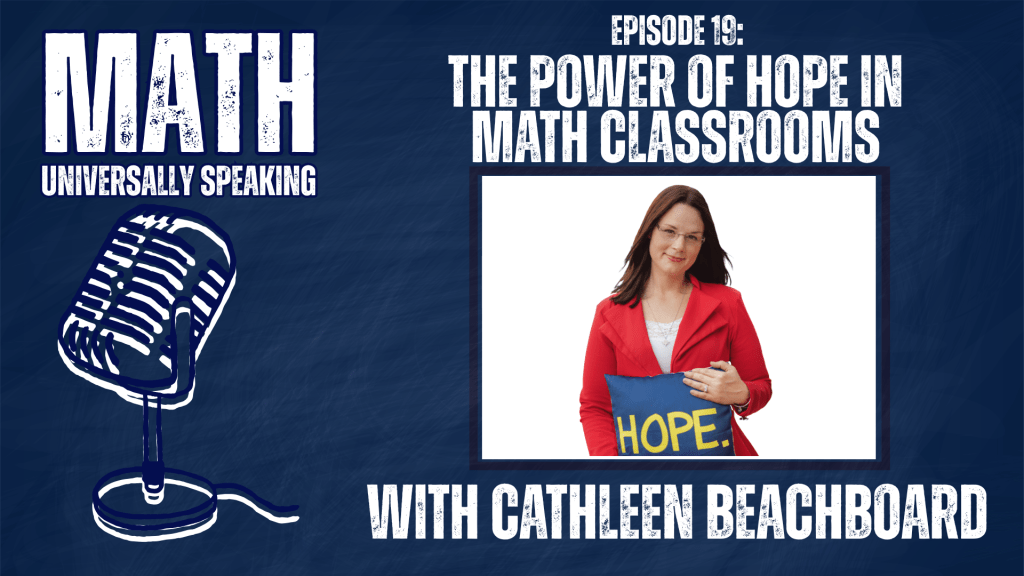
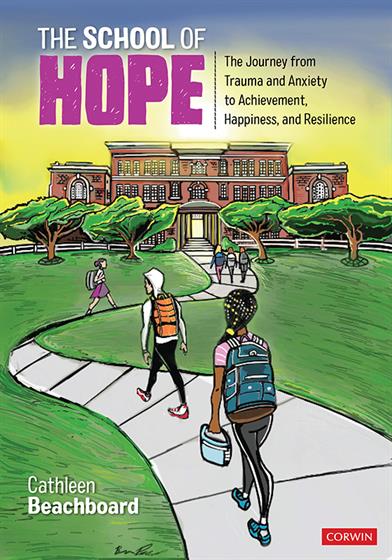
In this episode of Math, Universally Speaking, Ron Martiello talks with Cathleen Beachboard, author of School of Hope and a researcher in the science of hope. They explore how hope, motivation, and growth mindset can transform student learning, engagement, and achievement in math classrooms.
Cathleen shares her experiences as a classroom teacher, hope researcher, and parent, offering practical strategies for:
- Boosting student perseverance and problem-solving through hope
- Using asset-based language to build confidence and belief in students’ abilities
- Modeling growth, vulnerability, and resilience as an educator
This episode is essential for teachers, administrators, instructional coaches, and education leaders looking to create equitable, inclusive, and empowering learning environments. Learn how to measure hope, support student agency, and foster positive classroom culture that promotes lifelong learning.
Follow Cathleen Beachboard on Edutopia, LinkedIn, and Twitter to continue exploring the science of hope and its role in education.
Show Notes
Click on any of the links below to learn more about Cathleen and her work with with hope research.
One-pager on measuring and building hope
Digitized Kids Hope Scale (Google Form)
Interested in learning more or bringing this work to your school or organization? Connect with Cathleen here: https://theschoolofhope.org/contact
Transcript
This transcript has been professionally edited for clarity and readability. It reflects the content and intent of the conversation but is not a verbatim, word-for-word record.
Ron:
Hello, friends, and welcome to Math, Universally Speaking. I’m Ron Martiello, and today we have a very special guest. I had the opportunity to hear her speak this summer at UDL-Con, where she served as a keynote speaker. She is the author of School of Hope, a hope researcher, and someone whose work deeply resonates with me—both personally and professionally—especially in my journey supporting teachers and students in mathematics.
It is my pleasure to welcome Cathleen Beachboard. Cathleen, how are you?
Cathleen:
I am so glad to be here. This is awesome—and I love that this podcast centers on math. Math is near and dear to my heart, even though I teach English. People often assume, “Oh, you teach English, so you must not be good at math,” and I always respond, “I teach science too—math is part of who I am.” There’s a stigma around math that really needs to be broken, because math truly is universal.
Ron:
You just gave us our tagline. That’s fantastic. Cathleen, would you take a few minutes to introduce yourself and share your story with our listeners?
Cathleen:
Absolutely. I’m currently a classroom teacher—I’m still in the classroom. I’m also a psychological researcher, often referred to as a hopeologist, because I study the science of hope. Hope research is also grounded in neuroscience because of its impact on the human brain. I’m an author, but most importantly, I’m a mom.
I’m a mom of seven children. Five of my children were adopted all at once from a case of extreme abuse and neglect—because when we go big, we go big.
Ron:
I remember that story from your keynote. It’s incredible.
Cathleen:
Thank you. I was a teacher before I became a parent, and everything I believe about teaching—especially about math—comes back to my kids. I was told they could only do so much because of their trauma. That mindset reminds me of how we sometimes place students in math classes: They belong here. They can’t go there.
But who students were in the past does not dictate who they can become. When we label and sort students based on a single moment in time, we often limit their futures. Yes, differentiation matters, but the purpose of school is learning. In a strong classroom, students with very different needs can all grow.
Math, in particular, has the power to open doors—but only if we believe every child deserves the opportunity to thrive.
Ron:
That belief is exactly why you’re such a perfect guest for this podcast. In our book, Conquering Math Myths with Universal Design, we talk about the myth of sorting students—the idea that one data point defines a learner forever. Instead, we need to look at students’ thinking, ask questions, and understand their reasoning.
You mentioned you’re an English teacher, you’ve taught science, and you love math. When you think back on your own math experiences growing up, what stands out to you?
Cathleen:
Pressure and judgment. For many people, math becomes an early public sorting system—fast or slow, right or wrong, good or bad. Once that narrative sets in, it sticks.
I have dyslexia, and for years I was told I was “bad at math.” Eventually, a teacher noticed that my answers were correct—but misaligned. I was answering problem one in the space for problem three because my dyslexia made it hard to track visually.
Once a teacher slowed down, examined my thinking, and provided accommodations, everything changed. That teacher helped me see that I was capable. Math isn’t just about numbers—it’s often the first place students learn to doubt their intelligence. What matters most is belief: belief in effort, ability, and whether struggle means failure or growth.
Ron:
How powerful that you had a teacher who believed in your potential.
Cathleen:
Belief changes everything. There’s a well-known study where two teachers were given identical groups of students. One teacher was told her students were gifted—even though they weren’t. By the end of the year, her students’ test scores were 17% higher than the other group.
The difference wasn’t ability—it was belief.
Ron:
That’s a perfect transition into the importance of hope. Can you share more about that?
Cathleen:
Hope is measurable. There’s a Children’s Hope Scale—it’s free, easily accessible, and takes minutes to administer. What’s important is that hope isn’t inherited; it’s learned from environments.
Students with low hope often set lower goals and disengage more quickly, even if they have the skills. In classrooms, something remarkable happens when you intentionally seat high-hope students next to low-hope students. The lower-hope students’ achievement increases by 5–7%, and attendance improves.
Hope is contagious. When students are exposed to peers who believe, persist, and problem-solve, they learn those cognitive habits themselves.
Ron:
And that has long-term implications. I also see this with teachers. When teachers lack confidence in math, they sometimes rely on easier tasks. But when teachers model vulnerability—thinking aloud, asking for help—they create space for hope and growth.
Cathleen:
Absolutely. This connects to vulnerability research, including Brené Brown’s work. Schools often discourage vulnerability—failure is treated as final rather than formative. That applies to teachers too.
Administrators need to understand this: your primary responsibility is teachers. When teachers’ hope is supported, students benefit. High-hope teachers experience less burnout and greater job satisfaction. Hope is strongly correlated with meaning in life.
In my classroom, I model learning openly. I make mistakes on the board and name them. I tell students, “Thank you for catching that—you helped me learn.” That reframes failure as growth.
Ron:
As a former principal, I couldn’t agree more. Our job was never to manage teachers—it was to take care of them so they could take care of kids.
One of my biggest takeaways from your UDL-Con keynote was the concept of willpower and waypower. Can you explain that?
Cathleen:
Hope has three components: goals (whatpower), pathways (waypower), and agency (willpower). Schools often overemphasize willpower—“try harder, don’t give up”—without giving students pathways.
Willpower is like an emergency brake; it’s limited and depletes throughout the day. Waypower is knowing how to move forward when you’re stuck. In math, that means multiple strategies, permission to think differently, and supports that don’t feel remedial.
In my class, we do “problem speed dating.” Students identify where they’re stuck, then rotate through peers who offer strategies, empathy, or solutions. Everyone is expected to have questions. This normalizes struggle and builds waypower.
Ron:
That reflection piece is so often skipped, yet it’s where perseverance is built. Perseverance isn’t innate—it’s learned through strategies for getting unstuck.
Cathleen:
Exactly. Students aren’t just pushing through frustration—they’re navigating it. I also ask students to intentionally solve problems incorrectly and explain why those errors are common. Understanding misconceptions deepens understanding and builds creativity.
Math is creative when we allow multiple pathways.
Ron:
Before we close, I want to ask about asset-based language. What does that mean to you?
Cathleen:
Language shapes identity. In a study using identical math tests, one version included asset-based, achievement-oriented language. Students who received that version worked twice as long and scored higher.
All that changed was the language—words that communicated belief. That belief increased persistence and accuracy.
Ron:
Every student needs someone who believes in them—and needs to hear it out loud.
Cathleen:
When students are described as capable problem solvers in progress, they begin acting like it.
Ron:
Any final thoughts you’d like to leave with our listeners?
Cathleen:
Hope is a cognitive skill. It can grow. Teachers experience dips in hope too—especially during stressful times—but hope can be rebuilt by setting goals, embracing vulnerability, and continuing to learn.
I share my own learning with my students, including working on my PhD. When they see me struggle and persist, they see themselves differently. One student recently told me, “If you can do hard things, I can too.”
That’s why this matters. Hope predicts how we endure challenges—whether in math or in life. Sometimes students need to borrow our belief until they can believe in themselves.
Ron:
Cathleen, thank you for being our hope coach today. This conversation energized me—and I know it will energize our listeners as well.
For those listening, Cathleen Beachboard has a TED Talk, writes for Edutopia, and is the author of School of Hope. Cathleen, where can people follow your work?
Cathleen:
Edutopia is the best place to find my latest research. I also regularly share updates on LinkedIn and Bluesky. Wherever educators gather, I try to show up and keep the conversation about hope going.
Ron:
Thank you again for joining us on Math, Universally Speaking. Take care.
Professional Development Questions
- Hope in Learning: Waypower, and willpower influence student engagement, perseverance, and achievement? How can you intentionally cultivate hope in your classroom?
- Asset-Based Language: How does the language we use shape students’ beliefs about their abilities? What changes could you make to promote a growth-oriented, asset-based classroom culture?
- Modeling Growth and Vulnerability: How can teachers model learning, struggle, and problem-solving in ways that inspire students to persist and take risks?


Leave a Reply