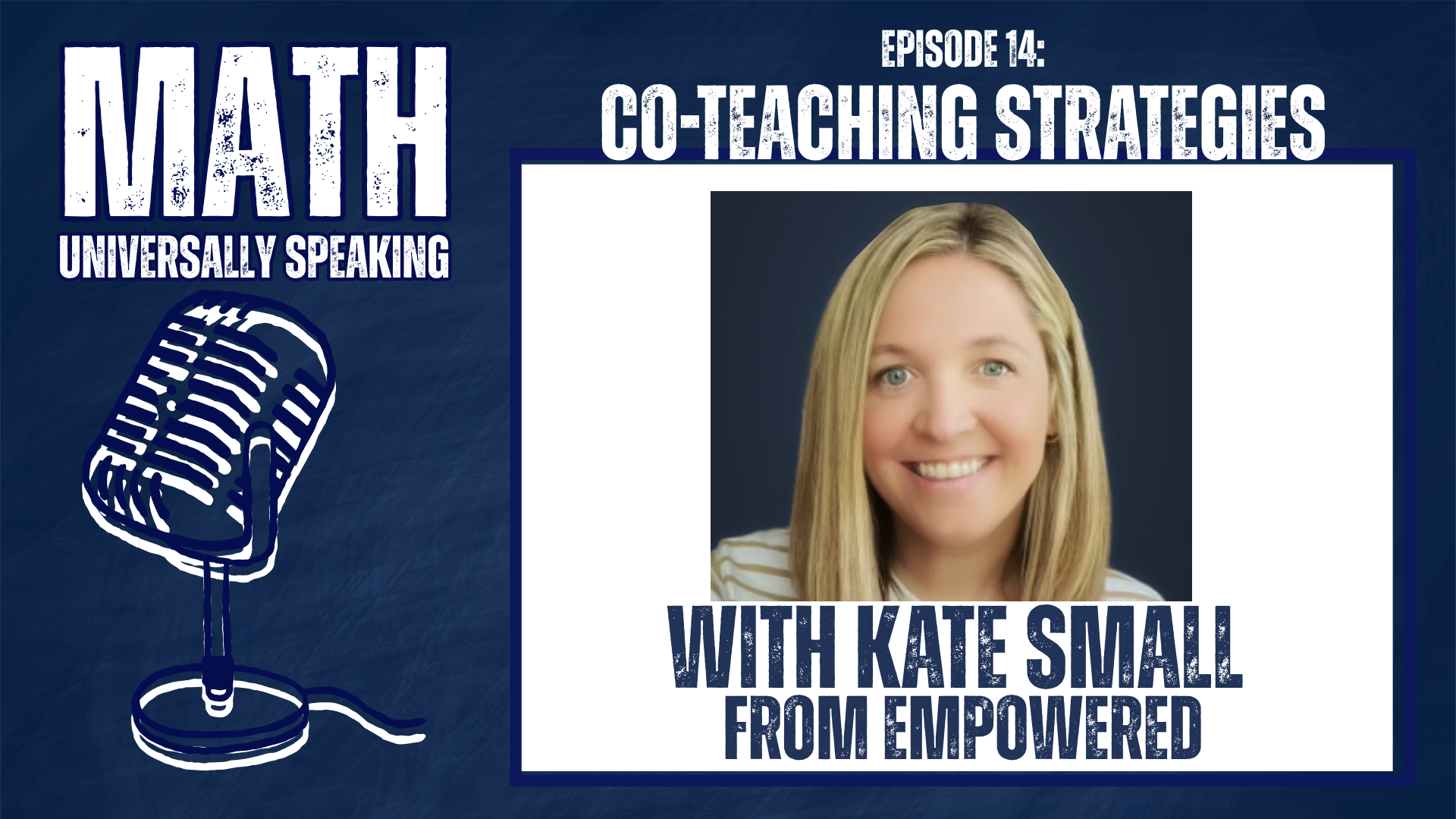





Episode 14 Description:
In this special episode of Math Universally Speaking, Ron reconnects with his former colleague and friend, Kate Small—an experienced educator, consultant, and passionate advocate for inclusive education. Kate’s background spans teaching in both general and special education, serving as an instructional coach, and working in administration before moving into national consulting. Now, she supports teachers and leaders across the U.S. in building stronger instructional practices, with a focus on co-teaching strategies, equity in math classrooms, and meeting the needs of diverse learners. Her experiences in and beyond the classroom give her a unique perspective on what it truly takes to make co-teaching partnerships successful.
Whether you’re a new teacher exploring how to co-teach effectively, a veteran looking to strengthen collaboration in the classroom, or an administrator supporting teacher teams, this conversation offers both practical co-teaching tips and professional inspiration. Ron and Kate highlight the heart of co-teaching: building trust, sharing ownership, and ensuring that all students—especially those with learning differences—have access to rigorous, student-centered math instruction. From co-planning strategies to leveraging each educator’s strengths, this episode is filled with insights to help you and your teaching partner create classrooms where every student can succeed.
Connect with Kate:
Instagram: @choosinginclusion
Empowered School Solutions: Website
Transcript
Co-Teaching Strategies with Kate Small from empowerEd
Introduction
Ron:
Hello and welcome to season two of Math, Universally Speaking, where we believe every student deserves access to meaningful math through strong, equitable instruction. I’m Ron Martiello, instructional coach, former administrator, co-author of Conquering Math Myths with Universal Design and your guide as we explore the intersection of high quality math instruction and inclusive practices.
This season, we’ll continue to bust common math myths, share practical strategies and highlight stories from educators from all over the world. Whether you’re a teacher, instructional coach or administrator, you’ll find ideas here to help all students thrive. Let’s keep building a community of educators who believe that math is for everyone. This is math universally speaking.
Interview:
Ron:
Hello, Math, Universally Speaking! This is Ron Martiello, and we are continuing on in season two of our podcasts, and we have a very special episode today. I get to introduce you to my colleague, my friend and an excellent educator. I’d like to say hello to Kate Small. Hi, Kate!
Kate:
Hi Ron. How are you?
Ron:
Good Kate, I’ve missed you. Kate, you and I worked together in the district I work in now, and I know that you’ve had some new adventures, but man, we had some really good times as part of the coaching team.
Kate:
Yes, yes, some of my favorite memories. And Ron and I worked together very closely, supporting some new teachers coming into that school district and making sure they had the right mindset, and, you know, the right heart set to do the job well. So it’s been great partnering with you. I’m happy to have this chance to talk
today.
Ron:
I am too. Can you please give us some of your background a little bit from before I knew you, up until what you’re doing now, because I know that you were doing some amazing things.
Kate:
Yeah, sure. So, as Ron said, my name is Kate small. I’m really happy to be here this afternoon. I am an educational consultant now in my new career path, and prior to taking on that role, I have taught special education, elementary education. I was the gen ed teacher. I was the special ed teacher. I’ve co taught. I served as an inclusion facilitator, an instructional coach, and had a very short stint in special ed administration, but really, my heart is in the classroom, where the teaching and learning happens. So now in my consulting role, I’m really fortunate that I have the opportunity to provide some coaching supports to educators across the United States. I work for a company called empowered school solutions, and we really work to build capacity amongst admin teams and teacher teams around supporting learner variability and shifting your practice to make sure that you’re meeting the needs of all.
Ron:
And ladies and gentlemen, this lady knows her math. She can teach math. I’m telling you. I’ve seen her co-teach with some of our friends from our school district. I have seen her in action, and she does her homework and just knows how to deliver and work with her general ed co-teachers. This is why this episode is so special, because today we’re going to be talking a little bit about co-teaching and what that looks like. And Kate, you have some ideas about some of the topics you want to talk about. What’s on your mind first? What is one of the things that you would like to talk about with co-teaching?
Kate:
So, you know, for me now, because I’m doing this, this, providing this support, I should say more nationally, right? I’m in California, I’m in Illinois. I’m in Arkansas. I’m in Massachusetts, so I really have the opportunity to kind of see instruction in multiple different places. And some of the things that I have found is that when we provide co-teaching training or co-teaching coaching to people that are new to this world of partnering together to collaboratively deliver instruction, some of the things that are really missing is that emphasis on building parity with one another, and parity is that idea of shared ownership, so both teachers really feeling empowered to teach the lesson, to address the students, to provide feedback, to assess, and then also the co-planning piece? I think a lot of districts have gotten on board with the idea that if you have co-teaching teams, they need to have co-planning time built into their schedule. But one of the things that I’m finding is, you know, of course, you can have that on paper, but if our two teachers don’t know how to maximize that time, it’s not always as effective as it’s intended to be. So that’s really where I’ve been focusing. My efforts with the teams that I’m supporting is really helping them to build that parity together and also understand some really great strategies for maximizing co teaching time.
Ron:
Let’s sit here with that parity piece, because you guys are generalists, trying to support teachers, whether you’re at elementary school, middle school, high school. You’re trying to get on board with what the content is. And I think there’s another leap there. Sometimes, when it comes to math, the higher you go, the bigger the leap. And that parity is difficult for special education teachers who are coming to it and they’re seeing the other person is like the master of the content.
Kate:
Yes!
Ron:
So talk to me about how you help people through that.
Kate:
Yeah. I love that you asked that question. It’s perfect. Because one of the things that I really work with Co-teachers on is this idea of, you know, we often hear the 50/50, split when it comes to a co-taught partnership, but we really have to rethink what that means, because when we talk about a 50/50, split, it doesn’t mean that the special ed teacher is coming in and doing 50% of what the general ed teacher would have done on their own. Right? It’s really starting from scratch and using 50% of each person’s expertise to kind of redesign the content, redesign the way that you’re delivering the instruction, to more meaningfully support kids.
So what I love about that is it’s perfectly fine to look at your co teaching pair and recognize we have one person that has really strong expertise in the content area, and we have one person who has really strong expertise in knowing ways in which students might potentially struggle and then how to break down some of those barriers, right? Because you need both of those people’s lens to really kind of create the perfect lesson, if you will. So that’s what I work a lot with my teams on, is really, then how do you have some of those better conversations to make sure that you’re tapping into each area of that expertise, to really design strong lessons?
Ron:
What would you say about the lens? Like you need, you need each person’s expertise to come to the table and deliver that strong instruction for our students, and it’s delivered in different ways. And that’s what good teams do, whether you’re a Duo or a team, a football team like, everybody has a role. It’s making sure that both partners feel comfortable in that role, and the general ed teacher like we’re looking for ways to, you know, attend to that variability. We’re looking for ways to be proactive, and, you know, provide choice for our students. And, you know, we have, we have a toolbox, but you have a toolbox, like, I might have the screwdriver, but you’ve got the pliers, and it’s like, we put it all together and we make it
work.
Kate:
Yes, and I will say, You gave me this great introduction that I can teach math, and I’m a math person, right? But I’ve always, you know, I go to your book, I’ve always operated under that myth of I’m not a math person, because for me, growing up, I struggled with math. And the reason that I struggled with math is, you know, the memorization piece was a challenge for me, and I am the learner that needs to understand the why before the how. So I felt like I never really had an opportunity to learn in that way. And what I’ll tell you is I work with this amazing co teaching team now. They co-teach high school math. So all three levels of high school math in their district. They’re affectionately known as the “Erins”. They’re wonderful. And you know, one of the Erins has that content area knowledge. She’s been teaching math for years. The other Erin is a special educator by trade, so they were partnered together, and the Erin who has the background in special education, while she has learned the math content really quickly and has really kind of held her own in terms of that expertise. She is so wonderful at really being able to teach the why behind some of these processes that we expect kids to apply. And her co-partner, her co-teacher…She is just so wonderful at really being able to break down the procedure and to support more of that abstract piece. So they really bring kind of the perfect balance to being able to work with these high school students who certainly have different starting points when it comes to the skills that they’re bringing into the classroom.
Ron:
So it’s not a matter of the 50/50. It’s not like, well, you take those kids, I’ll take these kids, and we’ll, we’ll both do our magic at different spaces, and it’s more along the lines of we’re all rowing together.
Kate:
Exactly. And I think too, you know, something that you message regularly is there’s not just one way to learn math, right? And these two teachers really exemplify that, because they themselves have different ways of thinking about. it. because of that, they play off of one another. They really model that for their students. They call it out, and the students feel so much more comfortable in that space because they recognize, you know, we all have different starting points. We’re all going to have different ways of thinking about this topic, and we can learn from one another. So I think it really kind of creates this beautiful learning environment where they see that happening amongst their teachers, and then they’re comfortable with
doing that themselves.
Ron:
So now that takes me into the planning piece, because we just can’t add water and this happens. Sometimes it’s like, you’re assigned to this teacher, and we’re gonna, you guys are gonna do that, and then we see what happens. But I think what you are talking about, like at the beginning of the episode, was more about what should happen during that planning time and how that relationship can be nurtured.
Kate:
Yes. And I feel like, for you, you know, in terms of thinking about math, this will make a whole lot of sense. So one of the books that I’ve read more recently, it was published, I believe, in the last 10 years. It’s by Toby Karton and Wendy Murawski, and it’s called Co-Teaching Do’s, Don’ts and Do Betters” (Karten & Murawski, 2020). And one of the ideas that they introduce in this book is that you should really think about your co-planning time in terms of mega planning, macro planning and micro planning. So it’s almost like there’s a pyramid, and there’s these three different levels that you need to work through as a co-teaching team. And your Mega level is really looking at your scope and sequence for the year, right? What are all of the standards that we have to teach within this year and doing a lot of the work that you talk about in your book, which is prioritizing, which standards are more important and deserve more time? Then you have your Macro level planning, so that’s looking kind of unit by unit or at each specific skill that you’re teaching, through the year and really anticipating where the barriers lie for students, what are the concepts that they’re going to struggle with, so that you can be proactive in thinking about some of those supports that you need to put in place for them and the more time you. talking to. Use which approach is going to work best, how you’re going to present the information to students. So what I support teams with really thinking about is prioritizing the mega and the macro conversations when they’re physically together in that shared planning time, so that both teachers always kind of have that big picture view of the course that they’re teaching. And then when you have those times for your quick two minute touch points throughout the day, that’s when you can really touch base and say, “Hey, tomorrow, I think we should parallel teach.” Or, “you know, we’re getting towards the end of this unit, let’s do stations on Friday, right?” Because you always have that big picture view. So to me, that has just been such a game changer in really maximizing co planning time and making both people feel like they have that 50/50, opportunity to share their expertise.
Ron
I love what you just said, and it reminds me of an analogy I remember from my leadership training years ago. Stephen Covey used to do, the “Big Rocks and the Little Rocks. And he would take, he’d take a big jar, and he’d take all the little rocks and put them in first, and then he’d take the big rocks and put them on top. And of course, they just sat on top,
Kate:
Yep.
Ron:
And so the little rocks take up all the space. But then he switched it up. He put the big rocks in, you know, we’re going to take care of these things. And then all of a sudden, like all those little rocks filled the spaces. They didn’t take a lot of space, but with the space. it didn’t take over the jar. So it all worked together. So I love what you’re saying, and if you can repeat
the…
Kate:
Hierarchy.
Ron
Thank you. Yes! Hierarchy.
Kate
Yeah. So it’s Mega planning, which is looking at your scope and sequence as a whole, from day one of the course till the last day of the course, all of the standards you’re teaching. Your Macro level is looking unit by unit to really anticipate those struggle points for students and where you kind of know that they’re going to need some additional support. And then, of course, your Micro level is looking at your everyday lesson plan. How are we going to present the information provide students the opportunity to practice? And then, of course, the product that they’re going to submit to you to show that they’ve learned. So really, again, the more time you spend at the mega and the macro level, the less time you’ll need to really touch base
about those day to day pieces.
Ron:
And what was the name of that book so we could post it on the on the website.
Kate:
Yeah. So it’s called Co-Teaching Do’s, Don’ts and Do Betters”, and that’s by Toby Karton and Wendy Murawski,
Ron:
Awesome. We’ll make sure that we put that in the podcast notes.
Kate:
Perfect.
Ron:
Awesome. So we talked about the relationships and the dynamics and what that might feel like for two co-teaching partners. You gave us an idea of like, how do we plan for this? Do you have any other practical tips for co-teaching pairs that kind of like, you know, just come to mind?
Kate:
Yeah. So my colleague, Dr Rufo and I, who Ron, I know, you know very know her,
Ron:
I know her.
Kate:
A great friend of yours, and colleague. Her and I have really been talking quite a bit around this idea that, you know, Marilyn, Friend and Lynne Cook. They really are the ones that have coined the term co-teaching, and they introduced us to the six models that exist back in the 90s. And lots has changed in education since the 90s, and while those models are still highly effective, we have new layers that are at play. Right? We have devices. In most districts students have a one to one device. We are post-pandemic, kind of still thinking about how we’re shifting our role as teachers from the deliverers of information to the ones that really have to focus on those soft skills, or those critical thinking and problem solving skills. So one of the things that we noticed is we sort of see a seventh model of co-teaching emerging, and what we’ve been calling this is Dual Facilitation. And what’s so powerful about Dual Facilitation is that it’s really taking your instruction from teacher-led to student-led. So for example, in a math class, both teachers might present students with a word problem that they want them to grapple with, and they send students off to work, either independently or in partner pairs or in collaborative groups. And then both teachers very intentionally move around the room, and they provide some direct support to students. If it’s needed, they provide meaningful feedback. What I love is I’ve seen some teachers kind of divide and conquer in the way that they provide feedback. So one teacher might be focused on feedback that’s directly aligned to the skill that students are applying or the particular concept that they’re learning, and the other teacher might be providing feedback around problem solving, really pointing out to students the areas that they see those standards in practice. And it’s just been really cool to watch the ownership flip a little bit in that co-taught class, because I think sometimes co-teachers naturally are given a class that may feel a little bit heavy in terms of the needs that are in that room, and so there can be times where you shy away from giving that independence to students, but this is just an awesome way that I’ve really seen two teachers still have a very valuable role in the learning that’s happening, but giving the control to students and giving them the opportunity to really do the work.
Ron:
So, this is quite a dynamic process. How does this work?
Kate:
So I’ve seen it done a couple different ways. In some cases, I’ve seen them kind of split the half, split the class, to make sure that they can give feedback to all within that time period. And then I’ve seen it done where their feedback, is focused on two different things, right? So one’s focused on the content, one is focused on problem solving. And then in that case, they might be seeing all students, so it’s just a matter of how they had the conversation prior to that lesson in how they’re addressing that feedback piece, because as the students are working, it gives them some time to check in, discuss the trends that they’re seeing. Another piece that I love is they really have a better sense of how the students are thinking about the problem, and then when they come back together with the whole group, they have a number of different models that they can pull and have students kind of teach their classmates. Here’s the strategy that we use to solve and then they really facilitate that awesome conversation around why another group did it differently, and it just creates this awesome space where everybody’s learning together.
Ron
We were talking about it before the podcast interview, and I made a connection to a book that the NCTM put out a couple years back called the 5 Practices (Smith & Stein, 2018),
Kate:
Yes.
Ron
Where we create a goal, anticipate the barriers, monitor, and then select students. And you don’t select the same kids all the time. And it’s not everyone show and tell. It’s like, you select like three kids, and then you sequence them like, Okay, I might have the student with the misconception first, misconceptions are okay to share with the permission of the student. And then two other examples that might lead you closer to the standard or concept you’re trying to teach. And then that’s the Connect It piece. So just for our general education teachers, who might be more math specific like this is the connection. The difference is, you’ve got two people there and they’re meeting the needs of all of our learners in the classroom
Kate:
Yep. Exactly right. And those teachers are often very intentional about how they’re grouping the students. Right? In some cases, I’ve even seen them sort of assigning roles so that the student who maybe doesn’t as willingly participate in those collaborative conversations, they really have a specific role in how they’re going to support their group, how they’re going to help with that problem solving piece. So again, I just think that’s a model that is not written about in the literature. It hasn’t been field tested, but it’s something that we’re seeing regularly, and I think it just speaks to all the changes that we’ve experienced in education since these co teaching models came out in the 90s.
Ron:
I love it. I love it. So let me ask you another question,
Kate:
Please.
Ron:
So, what advice would you give to a new teacher who is, whether they’re the special education teacher or the general education teacher, like, what’s some advice that we could give?
Kate:
Yes
Ron:
So, I want to speak for them too, because we want to get them on board with this. Where should they start?
Kate:
So you brought up the point way back at the beginning of this episode around, you know, special education teachers really having some general knowledge, right? They typically have a lot of knowledge in all content areas and really how to make the learning accessible. And sometimes your partner with a math teacher who’s been teaching this content for years, they can teach it in their sleep, right? They really know the processes inside and out. So one of the greatest things I can recommend to new co teaching pairs is plan a lesson together and then take turns. One of you delivers it one day, right where the other one kind of sits back and observes the other teacher teache it the next day, and you know, you have the opportunity to sit back and observe. Now, in some cases, that may require planning two lessons, right? If you’re seeing the same group of students from day to day, but I think that really opens the door to being able to talk about, you know, your individual strengths as a teacher, the areas where your co-teacher can compliment you really well, and it just helps both people to feel more comfortable, right? You get to kind of showcase your style, and then you talk about it. Where do we have similarities? Where do the differences lie? And then how can we support one another? So I think that’s a really important commitment to make as a new co teaching team. And then I think another piece that’s really important is even if your special ed teacher does not feel that they have the expertise in the math content where they’re going to be comfortable day one standing up in front of the room and modeling a specific procedure for students, what I would suggest is making sure that that person always has some type of leadership role within the lesson. So maybe it’s not delivering that direct instruction piece for the day. Maybe it’s when the whole group comes back together, speaking to the trends that they saw when students were working independently or in their small groups, or maybe starting off the lesson with a short review from the day before, or looking at a prerequisite skill that helps everybody to have the right mindset for entering this lesson. So I think there’s great ways to be able to do that, again, continues to help to build that parity throughout the year.
Ron:
Awesome, Kate, where can we follow you? Because you have such great advice. I know that you’re on Instagram.
Kate:
Yes. So you can certainly follow me on Instagram. My handle is at choosing inclusion, and I love to just post resources there. I’ve gotten really into AI lately, so I’m trying my best to kind of share some great AI resources that are out there for teachers to work smarter and not harder. There you can find me. You can find me at our empowered website. My email is linked there, so please feel free to reach out. I love supporting co teachers. I love supporting really all teachers, especially as you think about learning some new strategies for supporting students that have complex learning profiles and how we help them to learn all that’s available in general education. So please don’t hesitate. Reach out
if I can help you in any way
Ron:
Awesome.
Well, Math, Universally Speaking, I want to thank you for joining Kate and I today. This is again…Whenever I can interview a friend of mine who, you know, we share that vision for inclusive instruction, as well as that love for math. You know, it’s always, always a special treat. So thank you so much Kate for being on the podcast.
Kate:
Thank you for thinking of me. This was great. I’m so happy we got to reconnect, and I love listening. So I’m happy to get to share some thoughts.
Ron:
And if you have any ideas on co-teaching, models, co-teaching tips, or any of the advice that Kate has brought to you today, please feel free to share it at #mathuniversallyspeaking. We would be so happy to connect with you and keep the conversation going.
Take care.
Closing
Ron:
Thanks for tuning in to math. Universally speaking, if today’s episode got you thinking, inspired a strategy or challenged your mindset, I’d love to hear from you, and so would our growing Math Community. Let’s keep the conversation going on social media, using the hashtag math universally speaking, or connect with me on LinkedIn. You can also follow us at math universally speaking on Facebook and Instagram. Don’t forget, you can subscribe to our website, MathuniversallySpeaking.com and get the latest updates delivered to your inbox. Follow the podcast on Apple Podcasts, Amazon Podcasts, Castbox or Spotify so you don’t miss a single episode. Remember, math is for everyone, and together, we can make that a reality.
I’m Ron Martiello, Take care.
💬 Professional Development Questions
- How do you define parity in a co-teaching partnership, and what practices could help both teachers feel a sense of shared ownership in your context?
- When thinking about planning time, how might you and your co-teacher shift from focusing only on daily lesson details to also prioritizing “big rocks” ?
- What strengths do you and your teaching partner each bring to the classroom, and how can those strengths be combined to better support learner variability in math instruction?
Co-Teaching Do’s, Don’ts, and Do Betters
Click here to buy the book on Amazon
References:
Karten, T. J., & Murawski, W. W. (2020). Co-Teaching Do’s, Don’ts, and Do Betters. ASCD.
Smith, M. S., & Stein, M. K. (2018). 5 practices for orchestrating productive mathematics discussions (2nd ed.). National Council of Teachers of Mathematics.
Rufo, J. M., & Martiello, R. (2024). Conquering Math Myths with Universal Design: An Inclusive Instructional Approach for Grades K–8. ASCD.


Leave a Reply