Listen on your favorite platform.




Description
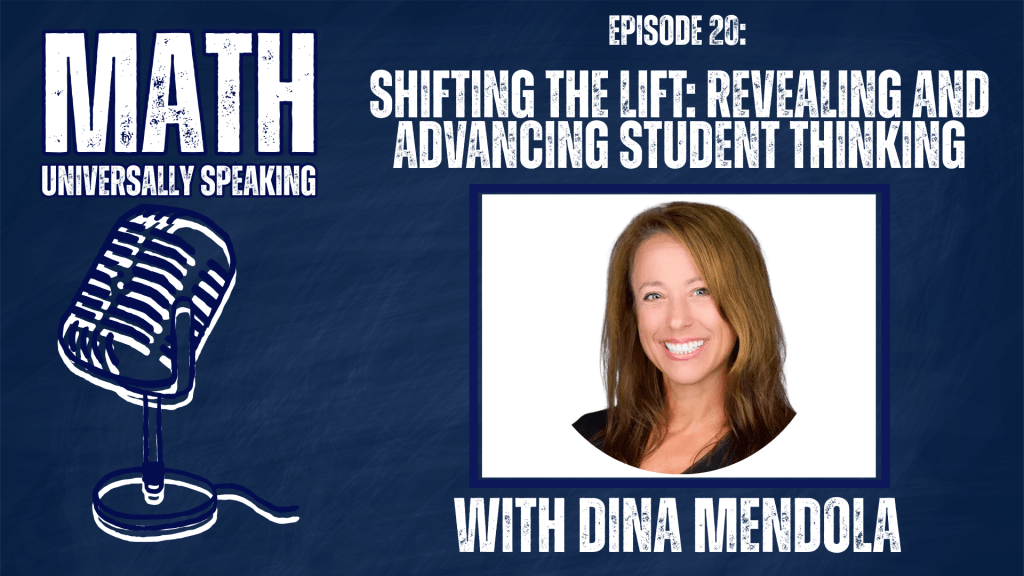
In this episode of Math Universally Speaking, Ron Martiello is joined by mathematics education consultant Dina Mendola for a thoughtful conversation on shifting the lift in mathematics instruction—moving the cognitive work from the teacher to the student.
Together, they explore what it truly means to reveal and advance student thinking, and why understanding how students reason, represent, and make sense of mathematics is essential for equitable and effective instruction. The discussion connects student thinking to math identity, instructional decision-making, assessment practices, and the role of teacher and leader support in creating safe, responsive learning environments.
Listeners will hear practical insights on:
- Making student thinking visible through discourse and representations
- Using assessment evidence to inform instruction, not just evaluate learning
- Supporting teachers in developing their own math identities
- Accelerating learning by connecting unfinished learning to grade-level content
- How school leaders can foster trust, curiosity, and instructional risk-taking
This episode is especially relevant for elementary, middle and high school teachers, instructional coaches, math specialists, and school leaders seeking research-aligned strategies to center student thinking and strengthen mathematics instruction.
Show Notes
Click on any of the links below to learn more about Dina Mendola and her work with educators and math.

References:
TNTP. (2025, May 13). Unlocking algebra: What the data tells us about helping students catch up. TNTP. https://tntp.org/publication/unlocking-algebra/
Transcript
This transcript has been professionally edited for clarity and readability. It reflects the content and intent of the conversation but is not a verbatim, word-for-word record.
Ron Martiello:
Hello, friends. This is Math, Universally Speaking. I’m Ron Martiello, and today I’m excited to welcome another special guest. I’ve had the pleasure of connecting with many incredible educators lately, and today’s guest is a new friend I met at NCSM in Atlanta back in October. We immediately hit it off—talking math, as everyone does at NCSM—and quickly realized we share deep alignment around a topic that is near and dear to both of us.
Before we dive into that, I’d like to introduce you to Dina Mendola. Dina, how are you?
Dina Mendola:
I’m doing well. Thank you so much for having me.
Ron:
Dina, would you take a few minutes to share your journey with math—where it began, where it has led you, and what your current role is?
Dina:
Absolutely. I often describe myself as an accidental math educator. I didn’t originally plan to become a teacher. I started out pursuing business, realized it wasn’t the right fit, and my mom—who always said I should be a teacher—ended up being right. Because of my business coursework, most of my credits transferred into math, which ultimately led me into education through that pathway.
Once I started teaching, I truly fell in love with it—especially with understanding how students think. I noticed that my students often had rich mathematical ideas, but the classroom structures and, honestly, my own instruction didn’t always make space for those ideas. Looking back, I can see how I unintentionally shut down thoughtful moments.
That curiosity led me to experiment with project-based learning, and I became deeply fascinated by student thinking. I wanted to be that math teacher—the one we all wish we had growing up—the teacher who serves as a pivotal point in a student’s learning journey.
Eventually, I moved into a district role as a K–12 math lead, supporting coaching, intervention, and curriculum work. One of the most significant turning points in my career was partnering with Dr. Dan Hinker at the University of Wisconsin–Milwaukee. She is one of the authors of Principles to Actions and Taking Action. Together, we worked on a mathematical leadership course and supported Common Core leadership across Southeast Wisconsin—at the same time she was writing Principles to Actions.
Ron:
That must have been incredibly exciting.
Dina:
It truly was. I can say without hesitation that I wouldn’t be where I am today without those experiences. That work fundamentally shifted my understanding of mathematics, particularly around conceptual learning, and deeply influenced how I approach teaching and leadership.
Ron:
It’s interesting how those shifts often happen later in life. We want to be that inspirational teacher for students, yet sometimes it takes until adulthood—and someone else’s influence—for that shift to occur. I was in my forties when that happened for me.
Dina:
Absolutely—and the shifts don’t stop. Teaching is vulnerable. Coaching is vulnerable. Learning is vulnerable. Growth requires a willingness to keep learning from one another. Math is vast, and there is always more to unpack. Even those of us in leadership roles are constantly learning and refining our understanding.
Ron:
That resonates deeply. As someone who supports educators, what is the math topic that is most central to your work right now?
Dina:
Lately, my work has centered on revealing and advancing student thinking—and, by extension, math identity. There is a strong push right now for reasoning, discourse, multiple strategies, and fluency, all of which are important. But the real work lies beneath that: Do we truly notice what students are saying? Do we understand their thinking deeply enough to respond meaningfully?
Too often, instructional decisions are driven by comfort or curriculum pacing rather than by student thinking. Supporting student-centered learning requires teachers to make in-the-moment decisions: when to use models, how to ask questions, how to advance thinking. That, in turn, requires teachers to deeply understand the strategies students might use and to know how to represent and build on those ideas.
This work isn’t just about students—it’s also about supporting teachers as learners. We’re not trying to understand student thinking for a test or an assessment; we’re trying to understand it so we can make purposeful instructional moves.
Ron:
That idea of getting to the heart of student thinking really stands out to me. In Conquering Math Myths with Universal Design, we talk about “assessing with the heart.” Sometimes that means stepping away from rigid assessment structures and sitting beside a student, listening, observing, and gathering additional evidence of learning.
Dina:
I love that. I’m currently working with a first-grade team that is starting to realize the importance of that approach. They’re asking questions during assessments: Are students counting all? Counting on? Structuring numbers? Rather than focusing solely on the final answer, they’re becoming curious about the process.
That curiosity is powerful. When teachers begin to internalize that mindset, you can see the shift—it becomes about truly supporting students rather than just evaluating them.
Ron:
I often say that teaching becomes easier when we allow students to do the cognitive work instead of forcing our thinking onto them. Do you see those “aha” moments with teachers?
Dina:
Absolutely. I’ve started using the phrase “shift the lift.” How do we shift the cognitive load from the teacher to the students?
I recently modeled lessons where we anticipated misconceptions and resisted the urge to rescue students. Instead, we asked them to solve problems using alternative models. In every classroom, students experienced powerful “aha” moments—and teachers were amazed by the depth of student discussion and willingness to be vulnerable.
That vulnerability is foundational to math identity. And just as important, teachers need to feel safe making instructional shifts themselves.
Ron:
Creating that psychological safety for teachers is critical. How do you intentionally do that in your work?
Dina:
I start by being vulnerable. I openly share my own math story—including the fact that I failed Algebra the first time. I also model lessons and reflect honestly afterward, naming what worked and what didn’t.
We have to remember that we’re developing both student math identities and teacher math identities. Many elementary teachers don’t have formal math backgrounds, and even those who do may not feel confident. Creating space for reflection, experimentation, and growth is essential.
Ron:
One of my favorite parts of this work is unpacking standards with teachers. When they see vertical coherence—where students have been and where they’re going—it creates so many “aha” moments.
Dina:
Absolutely. Math is a continuum. Understanding that trajectory helps teachers prioritize what matters most and shifts the mindset from “teaching for the test” to teaching for long-term understanding. It also reinforces the idea that all students are our students.
And when we talk about gaps, the research is clear: acceleration—not remediation—leads to greater gains. Supporting students with just-in-time scaffolds connected to grade-level content is far more effective than teaching from the bottom up.
Ron:
That aligns closely with the work from TNTP, especially The Opportunity Myth and Unlocking Algebra. Acceleration with support is the key.
Dina:
Exactly. It may feel counterintuitive, but when teachers understand the standards continuum, they can make those connections intentionally and confidently.
Ron:
You’ve worked extensively with principals as well. How can school leaders best support this work?
Dina:
Leaders need to engage in the math alongside teachers—observing classrooms, solving problems, and learning together. Coaching should focus on the person, not just the lesson. Trust, rapport, and psychological safety are essential.
Leaders must create space for experimentation and reflection without fear. Teaching is vulnerable, and learning requires risk-taking.
Ron:
That resonates deeply with my own experience as a principal. Curiosity—rather than judgment—allowed me to see the brilliance in teachers’ practices that initially didn’t align with my own assumptions.
Dina:
Exactly. Leading with curiosity opens the door to growth.
Ron:
As we wrap up, is there anything you’d like to leave our listeners with?
Dina:
Start small. One lesson. One problem. One student. Lead with curiosity and pause before jumping in.
I often share a story about a T-shirt my daughters made for me with a Superman logo—but an “M” instead. On the back it said, “Out to save the world, one math problem at a time.”
That’s our work. Teachers are change agents. We don’t need to turn the Titanic overnight—but small steps lead to meaningful change.
Some of the teachers who struggled most with math growing up become the most powerful math teachers. So start small, stay curious, and make it safe.
Ron:
One problem at a time. We’re all in this together. Dina, where can people find you?
Dina:
You can find me on LinkedIn under Dina Mendola, and on my website at dinamendolaconsulting.com. I’m always open to conversation and collaboration.
Ron:
Thank you so much for joining us, Dina—and thank you to our listeners for engaging in this work with heart, curiosity, and courage. Together, we can save the world one math problem at a time.
Professional Development Questions
- Revealing and Responding to Student Thinking
- How do our current instructional routines reveal student thinking, and how consistently do we use that evidence to make in-the-moment instructional decisions rather than relying on pacing guides or curriculum prompts?
- Math Identity and Psychological Safety
- In what ways do our classrooms—and our adult learning spaces—support the development of positive math identities for both students and teachers, particularly when mistakes or misconceptions arise?
- Shifting the Lift and Accelerating Learning
- Where might we intentionally “shift the lift” so students take on more of the cognitive work, and how can we connect unfinished learning to grade-level content to accelerate understanding rather than remediate in isolation?
 Math, Universally Speaking
Leave a comment