


Share this post.

Episode 18 Description:
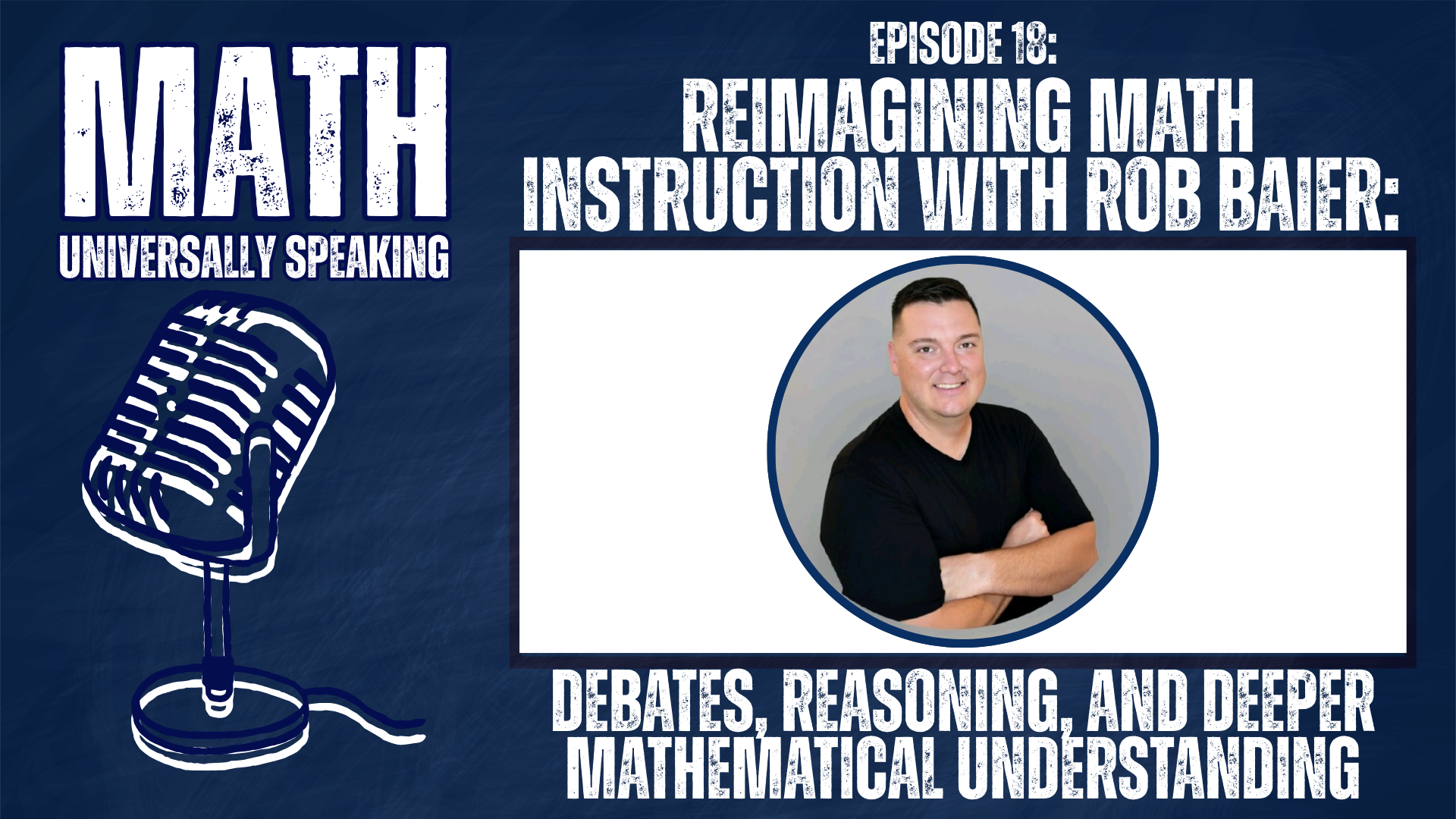
In this episode of Math Universally Speaking, host Ron Martiello explores how educators can move beIn this episode of Math Universally Speaking, Ron Martiello sits down with math educator and DebateMath co-host Rob Baier to explore how debate, reasoning, and student voice can transform math instruction. Rob shares his journey from district leadership to international math coaching, his work with Innovomat, and the power of structured mathematical debate in helping students build deeper understanding.
Together, Ron and Rob dig into the heart of mathematical debate—how fostering student voice, teacher voice, and genuine curiosity leads to deeper understanding. Instead of debating to “win,” they explore how structured argumentation helps learners make sense of ideas, justify their reasoning, and consider multiple perspectives. Rob shares why reclaiming debate as a respectful, evidence-based practice can shift classroom culture and empower everyone in the learning community to think more critically and collaboratively.
They also discuss emerging issues in math education, including the role of Mathematical Practice 3 (creating viable arguments and critiquing reasoning), the integration of debate into pedagogy, and practical strategies to create equitable, high-quality math experiences for all students. Whether you’re a teacher, instructional coach, or school leader, this episode offers insights and inspiration to get students talking, reasoning, and truly making sense of mathematics.
Transcript
Reimagining Math Instruction with Rob Baier: Debates, Reasoning, and Deeper Mathematical Understanding
Episode Transcript — Season 2, Episode 17
*This transcript has been professionally edited for clarity and readability and may not reflect the recording word-for-word.
Introduction:
Welcome to Season Two of Math, Universally Speaking, where we believe every student deserves access to meaningful math through strong, equitable instruction. I’m Ron Martiello, instructional coach, former administrator, and co-author of Conquering Math Myths with Universal Design. Your guide as we explore the intersection of high-quality math instruction and inclusive practices. This season, we’ll continue to bust common math myths, share practical strategies, and highlight stories from educators from all over the world. Whether you’re a teacher, instructional coach, or administrator, you’ll find ideas here to help all students thrive. Let’s keep building a community of educators who believe that math is for everyone. This is Math, Universally Speaking.
Interview with Rob Baier
Ron:
Hello friends, and welcome back. Today we have a very special guest—someone I actually just met recently at the NCSM Annual Conference in Atlanta. My friend brings a wealth of experience, deep knowledge, and honestly just an incredible amount of energy. He introduced me to so many people at NCSM, and I’m still amazed at the travel schedule he keeps and the passion he brings to every conversation about math.
Please welcome Rob Baier. Hi Rob, how are you?
Rob:
Hey Ron, great to be here.
Ron:
So Rob, we were talking earlier about some of the exciting things you’re working on. Could you share a little bit about your story, and then we’ll jump into your latest adventures?
Rob:
Yeah, absolutely. So, I spent about four and a half years at IU1 as a math specialist. After that, I became the Executive Director for K–12 Math and Science at Pittsburgh Public Schools. I loved that role—loved the people, trusted the teachers and the team I worked with. I honestly never imagined leaving.
But then I met a group of fifteen math educators from Spain at NCSM in Chicago. Their energy was unbelievable. They’re part of a math education company called Innovamat, and their passion for math runs day and night—literally day and night. My WhatsApp is constantly buzzing because all they want to do is talk math and make the world better through it.
And I realized that so much of what I had been coaching teachers on for a decade aligned perfectly with their core values. Three weeks after meeting them, I signed a contract and left K–12 education to support districts around the world.
At the same time, I was presenting nationally—NCSM, NCTM, CMC South—and running the PCTM conference in Pennsylvania for two years. And of course, there’s our podcast, DebateMath, which I co-host with Chris Luzniak. It’s really his brainchild; I just ride his coattails. The podcast is all about debating math topics and pedagogy through structured, reasoned conversations. We believe not everything is black and white, and most disagreements come from different definitions or perspectives.
We want to bring debate, argumentation, and reasoning into math education in powerful ways. I also recently gave an Ignite talk at CMC South about being a “Nexus”—connecting people to people, people to ideas, and ideas to ideas. That’s really what drives me.
Ron:
I love that. And I completely relate—this work puts us in contact with people who bring such different perspectives, and every conversation makes us think differently. And yes, in the spirit of DebateMath, I joked with Rob earlier about the Muhammad Ali poster behind me as we were getting ready to talk.
Listening to your show, there’s something powerful that happens in those debates. It’s not just argument for argument’s sake. Can you talk a little bit about that?
Rob:
Yeah, definitely. Chris and I always say we want to reclaim the word debate. In politics, debate has become two people yelling over each other without providing real substance. But a true debate is a structured conversation supported by reasoning.
We believe people are absolutely allowed to have opinions—but they should also be able to explain why. That applies in education too. As a teacher, when I asked, “Why are we doing it this way?” and the answer was “Because that’s how we’ve always done it,” I immediately had a problem with that. If something is worth continuing, we should be able to justify it. And if we can’t justify it, we should reconsider it.
As math educators, we have a beautiful opportunity to help students justify their reasoning and critique the reasoning of others. That’s Mathematical Practice 3, and honestly, it’s my favorite. It’s where so much powerful thinking happens.
Ron:
That’s one of my favorites too. And listening to your episodes, what strikes me is that the goal isn’t to “win.” There’s no winner in these debates—there’s only understanding.
I recently listened to the episode about whether we should teach the analog clock, and I found myself right in the middle. I saw both sides. The conversation really opened my mind, especially around using the analog clock as a model for time, which is such an abstract concept for young learners.
Rob:
Yeah, that episode surprised me too. Going in, I was strongly against teaching analog clocks—just like I am with cursive writing. But as the guests started talking about analog clocks as tools for teaching measurement and fractions, I realized there’s real value there. My thinking shifted.
And that’s exactly why we don’t declare winners. A debate with reasoning lets everyone learn from both sides. We’re all winners when we grow our understanding.
Ron:
That’s so true. What have been some of your favorite debates so far?
Rob:
A few stand out.
“I Do, We Do, You Do” – This one got heated, with guests like Christopher Childs, Lisa McConchie, and Crystal Watson. It was a strong debate with big implications for instruction.
“Is a Hot Dog a Sandwich?” – This was a fun one with Kyle and Jon from Making Math Moments. We split them up and had them debate alongside their daughters. It was chaos—in the best way—and it led to deep thinking about definitions.
“Should We Get Rid of Algorithms?” – Pam Harris and Vanessa Marcie debated this one. It became intense but ultimately sparked collaboration between them—they even presented together afterward. That’s the magic of these conversations.
Ron:
And I’ve seen this energy firsthand. Even at conferences or restaurants, you all dive right into math debates. People from all over the country, different perspectives, different experiences—and yet everyone is deeply engaged.
What conversations do you hope teachers are taking back into their schools after hearing these debates?
Rob:
Great question. At the end of every episode, we encourage listeners to reflect on what resonated and share it with colleagues.
I hope our episodes spark real conversations in buildings—among teachers and between teachers and administrators. You can’t shift instruction without a shared vision. Topics like:
– Should we use “I do, we do, you do”?
– How do we feel about the science of math?
– Should we teach analog clocks?
– What should memorization look like in math?
These are schoolwide conversations worth having.
Our second-ever episode was about memorization with Lisa McConchie, who brought a neuro-cognitive perspective many educators hadn’t considered. Those are the conversations that can truly change practice.
Ron:
Looking ahead, what issues do you see emerging in math education?
Rob:
Two major areas.
Artificial Intelligence.
AI is evolving faster than we can keep up. At the Making Math Moments Summit, Christopher Childs demonstrated an entire interview conducted with AI—including AI-generated voice questions. It was astonishing. No one fully knows yet what AI will mean in math classrooms, but we need to stay curious and informed.
Multilingual Learners.
This is huge. When I worked at Pittsburgh Public Schools, students arrived from all over the world with languages I had never encountered. It was soul-crushing to admit, “I don’t know how to support these students.” And yet, they often knew the math—the barrier was the language.
And what we call the “standard algorithm” isn’t standard globally. Long division, multiplication algorithms—they vary widely. So we need to rethink what “standard” really means and how we support students who bring different mathematical backgrounds.
Ron:
Those are critical points. Communication barriers, cultural differences in mathematical representations, and building relationships with students—all of these deeply affect learning.
Rob, thank you so much for your time today. This was a shorter conversation, but we packed a lot in. Do you have any final thoughts or anything coming up that you want to share?
Rob:
Yeah, I just want to leave listeners with this:
Students’ voices matter. Their reasoning matters.
Whether it’s a computation problem or a contextual task, get students talking. Ask:
– Convince me.
– How do you know?
– Tell me everything you know about this.
Kids know far more than we realize, and when we give them the chance, they really surprise us.
And this goes beyond students—promote reasoning among colleagues, between teachers and administrators, and throughout your building. Ask “why” often and courageously.
Closing:
Thanks for tuning in to Math, Universally Speaking. If today’s episode got you thinking, inspired a strategy, or challenged your mindset, I’d love to hear from you, and so would our growing Math Community. Let’s keep the conversation going on social media using the hashtag #MathUniversallySpeaking, or connect with me on LinkedIn. You can also follow us at Math, Universally Speaking on Facebook and Instagram. Don’t forget to subscribe at mathuniversallyspeaking.com to get updates delivered to your inbox. Follow the podcast on Apple Podcasts, Amazon Podcasts, Castbox, or Spotify so you don’t miss an episode. Remember, math is for everyone—and together, we can make that a reality. I’m Ron Martiello. Take care.
💬 Professional Development Questions
1. Instructional Reflection
When observing students during problem-solving, what types of evidence do you currently collect about their mathematical thinking—and how might you make that evidence more visible to guide your next instructional decisions?
2. Shifting Mindsets
How does your classroom culture currently communicate what’s most valued in math—speed and correctness, or reasoning and perseverance?
What intentional moves could you make to reinforce that math is about thinking and sense-making, not just answer-getting?
3. Assessment for Learning
How might you redesign a recent assessment or task to emphasize students’ reasoning processes rather than just their final answers?
What feedback strategies could you use to help students reflect on and strengthen their mathematical thinking?
Resources
Making Math Moment Digital Summit
The Make Math Moments Virtual Summit is a free, three-day online conference (November 14‑16, 2025) for K‑12 math educators. Featuring 30+ influential speakers, this high-impact professional development event offers strategies to deepen teachers’ mathematical content knowledge, improve pedagogical practices, and spark student engagement — all from the comfort of your home. Participants can earn PD certificates and access session replays.
 Math, Universally Speaking
Leave a comment