



Episode 16 Description:
In this episode of Math Universally Speaking, Ron Martiello sits down with educator and innovator Beth Stark to explore how Universal Design for Learning (UDL) transforms teaching and empowers every student to thrive. Together, they discuss how thoughtful design — not rigid routines — helps teachers overcome barriers, honor learner variability, and foster deeper understanding in mathematics.
Beth also shares the story behind Ludia, an AI-powered UDL thought partner she co-created to support educators worldwide. Discover how AI can enhance, not replace, teacher reflection and collaboration — and how designing for every learner leads to engagement, access, and belonging for all.
Resources and Information

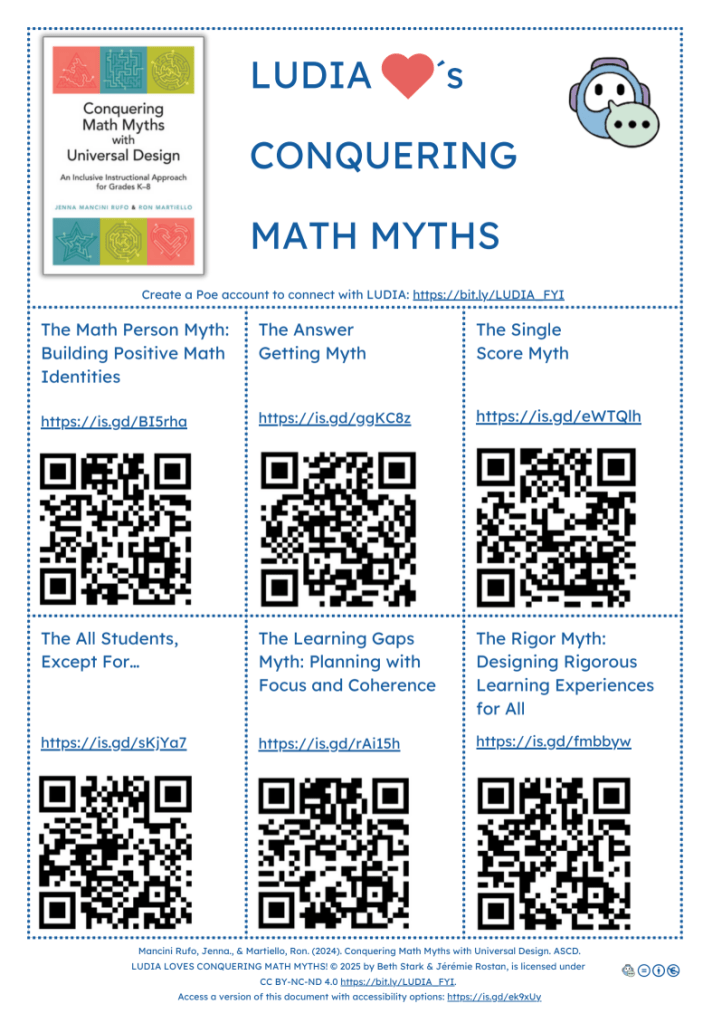
Ludia Loves Conquering Math Myths
Thank you to Beth Stark for creating a resource using Ludia as a thought partner while reading Conquering Myths with Universal Design. Ludia can be your AI companion as you read and explore topics in each chapter. Click on the graphic on the right to explore this powerful resource, while learning more about the intersections between designing powerful math lessons with Universal Design for Learning.
Transcript
Designing for Every Learner: Universal Design for Learning and AI with Beth Stark
Episode Transcript — Season 2, Episode 16
Introduction:
Welcome to Season Two of Math, Universally Speaking, where we believe every student deserves access to meaningful math through strong, equitable instruction. I’m Ron Martiello, instructional coach, former administrator, and co-author of Conquering Math Myths with Universal Design. Your guide as we explore the intersection of high-quality math instruction and inclusive practices. This season, we’ll continue to bust common math myths, share practical strategies, and highlight stories from educators from all over the world. Whether you’re a teacher, instructional coach, or administrator, you’ll find ideas here to help all students thrive. Let’s keep building a community of educators who believe that math is for everyone. This is Math, Universally Speaking.
Ron:
Hello, friends. This is Ron Martiello, and welcome to another episode of Math Universally Speaking. You know, I am so fortunate to have the guests that come onto the show, and we have a very special guest here today, and so I would like to introduce you to Beth Stark. Hi, Beth.
Beth:
It’s so great to be here, Ron. Thank you for the invitation.
Ron:
Hello. This has been a work in progress over the past couple months, and, you know, you and I have both been busy, but we finally got it together. We had a very interesting meeting on LinkedIn. Do you remember that?
Beth:
Oh, I do, yes. In fact, we hadn’t met, and I just wanted to give you a shout out because I had been reading and bookmarking your amazing book that had been published a few months prior to my post. And that’s how we got linked up on LinkedIn.
Ron:
Yeah, I sent you a message. I’m like, “Hey, I kind of, I see you’re having a workshop I’m attending,” and you’re like, “Oh my gosh, I’m reading your book right now.” That was such an honor. I mean, I got chills that night. I got serious chills. I was showing my wife. I’m like, “Look at my phone. Look at this.” So it was fun.
Beth:
Yeah, it was great. I mean, I didn’t want to, I didn’t want to give myself a plug there. But, yeah, I was also incredibly honored that you were scheduled and registered to attend a webinar that Jeremy and I were facilitating, actually, for a wonderful group, the Open Access Group in California. That was a great time.
Ron:
Very good. Beth, you know, some of the audience from Math Universally Speaking may not know you yet. So if you could just take a couple minutes to introduce yourself and tell us about your very important work.
Beth:
Oh, well, thank you for the opportunity. I’m actually joining you from my home in Dresden, Germany, but you can tell from my slightly nasally accent. I grew up in the Midwest of the US, the suburbs of Chicago, and way back in 2007 I put my cat in a carrier and packed up all my belongings and hopped on a plane and began my adventure as a Learning Support Coordinator at an international school here in Germany. And slowly but surely, the international education community became my community. I’m really passionate about the International Baccalaureate and all that can be gained from an international education. A few years back, I decided to kind of end the difficulties that came along with consulting and coordinating at the same time, and now I am a full-time consultant for international schools. My specialty, of course, is my passion, Universal Design for Learning. I also really appreciate all that thoughtful integration of technology approaches and platforms can bring to the classroom and learning spaces, and they also really work well — or hard, I should say, I hope well — with teams to really think about phasing in tiered systems of support so that it isn’t disruptive but actually complements all the good work that’s already happening in schools.
Ron:
That’s awesome. Can you frame out — and we had a little bit of a conversation prior to the interview — to just frame out what the International School experience is like? Because a lot of our people have been listening from the United States.
Beth:
Yeah, well, I can tell you, from my perspective, I had no idea that there was a whole world of international education out there, and it’s grown so much since I began in 2007. You’re going to have a variety of types of schools, but for the most part, these schools are nonprofit organizations that oftentimes receive some kind of funding from their region, but they’re really focused not on making a profit, but on bringing the opportunity for all of the students to develop as global citizens. Many of the schools offer the International Baccalaureate continuum of programs. So many of you in the States might be familiar with the DP program, the Diploma Program, but there are several other programs that the IB offers. Not all international schools offer the IB, but many of them do, and there’s lots of benefits to an international education, especially for families that are working and living around the world, and that might be in intervals of two to five years because of the employment obligations of one or both of the parents or caregivers. It might also be something that families who are able to live remotely choose to do. So it’s a growing community, and it’s a wonderful, wonderful culture as well.
Ron:
So, and I’d say that really speaks to me. As I shared, I grew up in a little row home in Northeast Philadelphia, where my world was the New Jersey shore and the Poconos mountains and everything was within two hours of itself. So to be speaking to you in Germany, and for those of us who may have had humble beginnings but then may want to venture out, that sounds like a very exciting opportunity.
Beth:
I’m so glad you brought that up, because there is nothing sophisticated or intimidating about the world of international education. It’s a wonderful mosaic of people from all different backgrounds who have a shared passion for high-quality education, and it’s a very welcoming community. Many people stumble upon it, and others seek it out. If you are interested in pursuing the international Ed pathway, I’d really recommend that you look into a search, which you can register for through several different organizations. One that comes to mind is Search Associates, and it’s definitely worth a Google. There’s lots of opportunities out there to get your resume out there and go to a job fair and to make a connection with the school that’s just right for you and your family.
Ron:
And you know, that is something that I’ve learned, even in the small area that I’ve been in in Pennsylvania. Like, I’ve been able to make moves in. You know, I love education, but I’ve been more than just a classroom teacher, and some people could spend 30 years in a classroom, and good for them — we need you. And there are others like me who like to make moves, and I’ve been very fortunate to have a lot of different positions and different experiences. But that is just for those of us who might look for something even in a wider range, more global range. It sounds like a great opportunity.
Beth:
Yes, it’s definitely, for better or for worse, a great adventure as well.
Ron:
Awesome. I heard you say you packed — you say you packed up your cat.
Beth:
I did.
Ron:
And your cat right on. Out you are a Learning Support Coordinator.
Beth:
I was, yeah.
Ron:
What led you to Universal Design for Learning?
Beth:
It’s really my roots. I originally studied developmental psychology in my undergrad and then went on to pursue a master’s in special education with a very special concentration and certification for teaching students who are blind and low vision. David Rose and Meyer’s work was front and center with all of my professors, and Teaching Every Student in the Digital Age was actually one of my books when I was receiving my — I should say, working for my degree. Beyond just having access to that book, I was really fortunate to work with just a group of very open-minded and progressive professors who really encouraged us to hold on to our idealism. At the time, we were being trained to be integrationists, which is a term that we don’t use anymore in 2025, but indeed, that’s what we were going to be doing. And that’s what I did as an itinerant teacher for students who are blind and low vision.
And that was then, and this is now. Universal Design for Learning has evolved so much since that time, and it was always meant to evolve as a flexible framework. I took a little bit of time off when my children were born. I had parent time, which is protected here in Germany, and that was a special time. When I came back to my position, UDL 2.0 had been released, and it was now a framework truly for everyone.
In the educational world, and not to say it wasn’t before, but certainly it was accessible and refined in such a way that I became a full-on cheerleader. I look back at an accreditation report that our school received after that process of being accredited — which probably sounds a bit strange for people in public schools, but in an independent or private school, it’s important to maintain certain standards — and in that report, you can see that UDL would be ideal for the school to work through and develop capacity in. That was so many years ago, but I can see the influence, and I can also see the importance of good timing.
Here we are now post-COVID. We’re really trying to live our best intentions, and we’re working towards authentic impact for the learner, and that’s where Universal Design for Learning comes into play.
Ron:
I want to dive deeper into what you just said about authentic impact. Many times, as educators, we’re on the treadmill. We have a bag of tricks, or we have a bag of tools, and we implement them, and we stay on schedule. That impact — what does that look like for you?
Beth:
I am really proud to be a purist. That doesn’t mean I’m self-righteous, but it definitely means that simplifying and reducing UDL down to a collection of differentiation strategies is not honoring the framework. If we really want to work towards impact, we need to go back to the roots and the intentions behind Universal Design for Learning, and that’s where I believe the impact really lies. When we think about designing to ensure that all learners, each learner, has an opportunity to grow and develop — that’s not going to happen with a bag of tricks. We have to really inquire.
And that’s what I really appreciate, by the way, about your book. We have to really inquire and develop our own capacity for introspection. There’s a lot of syllables there in that statement. You really want to create an environment in the classroom that ensures that all learners have not just the tools at their disposal, but the kind of facilitation, right from that instructional leader, that teacher in the classroom, that is going to guide them towards growth. We have to rely on the roots and intentions behind the framework. When I say to groups of teachers, there’s one sticking point — one “do not pass go” — and that is: the deficit is not in the learner; the deficit is in the learning design and the environment. And let’s just stay there and work through that together, because if we want to achieve impact, we really need to inquire about our beliefs in that statement. That’s going to take more time than just accessing a toolbox of strategies.
Beth:
You know, that is what has hooked me on Universal Design for Learning: the design. I love making connections and building bridges between what the goal is and what the outcome needs to be, overcoming those barriers in between, and providing those options. For me, especially with mathematics, I have learned it’s built on a system of progression. It’s not about the one test or the one strategy. It’s about thinking and reasoning and developing a system that students can continue on in their learning. One grade level should be handing off to another grade level, and one teacher handing off to another teacher, but being able to empower the learner to make those choices, to exercise their agency as they’re moving through our system, is really important. That’s where those leverage points are — being able to show our thinking in different ways. That’s one of the big myths that we talk about. It’s not about tricks and tips. It’s more about understanding.
Beth:
I appreciate that so much. I just want to add to what you’re saying. When we think about design, it’s really about that iterative cycle, right? You’re never done as an educator. I think that’s such a wonderful issue: always looking, not for the flaw or character deficit in the learner, but really holding them in high regard and focusing our time and energy on the design of the learning itself. It’s such an energizing pursuit. I really love it when teachers’ eyes light up, when they see that this is a really specific and flexible framework that can work with them in that pursuit. It’s wonderful work.
Ron:
Where do you start? As you’re working with teachers and consulting, where do you start as you give them permission for this iterative cycle and pursuit?
Beth:
Oh, that’s — you know, I give them choices, right? So it’s really not just up to me. I want them to feel that optimal discomfort, right? There’s a little bit of troublesome knowledge when it comes to turning the switch on to Universal Design for Learning. As a designer, I work to optimize their autonomy by giving them purpose-driven choice. I also want to minimize the threat that comes naturally with any change. One thing, regardless of where you are in the world, teachers are so dedicated to their work and their identities as professionals. So when you’re talking about a new framework, or a new way of thinking, or positioning themselves in the classroom or the learning space, you have to design to ensure that they feel a sense of validation for the wonderful work they already do, and a sense of safety to consider other perspectives and the possibility that this could be the right time for a change.
Ron:
I’ve seen teachers struggle with that in my work, yeah, with math. It’s like, “I’ve been the math teacher for this many years, and I’ve been teaching,” and then all of a sudden, you open this new world, and they’re a beginner again. But their identity is, “I am the math person.” That is a real thing.
Beth:
It is, it is. I think really making sure that, as a consultant or a leader in a school, we’re holding all learners in high regard — that includes teachers. This isn’t about a yay or nay. This is a journey. Part of really respecting them as professionals is giving them the space and the resources to experiment as learning designers, and not looking at this as a lockstep approach that needs to be implemented by XYZ on a timeline. It won’t work. We need to clarify goals for the teachers and then scaffold flexible pathways for them.
Ron:
That’s awesome.
Ron:
You’ve taken your knowledge of Universal Design for Learning to another step, and over the past couple of years, artificial intelligence has become a big buzzword. Everyone is racing to put a stamp on it or harness that energy. We’re trying to make sense of it, and I think you’ve taken some good steps with your next adventure.
Beth:
Yeah, well, I’m just like everyone else. We all have mixed emotions. Sometimes it’s unbelievable, and other times it’s frightening because it’s incredibly powerful — this thing we call artificial intelligence. Shortly after ChatGPT was released, I started an experiment. I wanted to find ways that teachers could leverage ChatGPT to receive UDL-informed responses or predictions. This was way before prompting was a thing. I was failing miserably with my experiments.
I reached out to my esteemed colleague, Jeremie Raston, who was in Yokohama, Japan at the time. He’s a great writer, AI enthusiast, passionate about pedagogy, and a leader in the international ed community. I came to him with this idea, this ambition, and slowly but surely, we started writing, iterating, researching, and experimenting. Because of his expertise — not just in AI, but also as an educator — we combined our strengths and developed Ludia. Ludia stands for — or is a remix of — the acronyms UDL and AI.
Ron:
Really? I did not know that. Oh my word.
Beth:
It’s a chatbot we coined as a UDL thought partner. It’s expertly engineered — I don’t use the word “expert” daily, but you could say that. It’s a one-trick pony. A chatbot designed to support educators, learning designers, and school leaders to receive guidance and support through the lens of UDL, for nearly any question about teaching and learning.
Ron:
I can say I have used Ludia in my coaching experiences with teachers. I like to sit down, elbow to elbow, share the screen, and type in prompts. As teachers start seeing amazing things come up, they start asking questions, or tapping on the questions that relate to what they want Ludia to do. Then we forward the chat to them so they can continue the conversation on their own. It’s been wonderful — it helps teachers think about their practice, their goals, and how they can overcome barriers.
Beth:
Oh, that’s great news. It’s exciting to hear someone like you, who’s influential, using Ludia as a thought partner to support teachers. Ludia is designed to gently redirect any user. For example, if you prompt, “I have this student who refuses to recite poetry in front of class,” Ludia will not frame it as a deficit in the learner. Instead, it reframes the issue: the design may be misaligned. Ludia shows suggested or potential barriers, gives annotated guidance on reducing barriers for that learner or all learners, and provides hot-linked, flexible pathways to continue that exchange.
What you see with ChatGPT alone is reliable guidance, but you won’t see UDL-informed guidance about reframing the situation. You’ll probably get a word waterfall of strategies to support or extinguish behavior. Ludia is designed as an iterative design partner — you can always continue to identify and reduce barriers and share specific information about learners or learning goals.
Ron:
As much as we love to collaborate with peers, sometimes we’re isolated. We still need a thought partner. With busy schedules, common planning time might not exist. A Google search won’t do it, and ChatGPT has limitations. Working with Ludia myself, it brings up framework considerations and says, “Have you considered these things?” Then you can continue on and carry the conversation to peers. In our Teacher Induction class, we have teachers use Ludia in pairs, elbow to elbow, and we’ve seen powerful collaboration happen. It doesn’t always have to be isolated.
Beth:
That’s wonderful. We’re coming up on three years of Ludia. I can’t say this enough: Ludia is a one-trick pony. It’s not designed to be fancy; it’s designed to do one thing well and reliably. We have teachers and leaders from almost 120 countries using Ludia. The goal is not profit, not data collection, not advertising. It’s purely to expand access to Universal Design for Learning. We’re just getting started.
Ron:
Excellent. We can’t wait to see where that adventure takes you and Jeremy. You also made something special for our audience that we’ll share on the website.
Beth:
Yes, I encourage everyone to read your brilliant book and to take advantage of further conversations and exchanges you can have with Ludia. Disclaimer: we did not train Ludia on your book, and there is no copyright infringement. Any mention of your book is just to put it in people’s minds so they buy their own copy. We had a joy creating that choice board.
Ron:
We appreciate that. Jenna Rufo and I have invested heavily in this work. One thing I learned from UDL Con — congratulations, by the way, on your honorary award for Ludia — is that we are all learners. We seek expertise but are always growing. We appreciate how you push this work forward and keep it evolving through UDL and Ludia. We can’t wait for the next steps.
Beth:
Thank you so much for having me on the show. It’s been so much fun and a real honor.
Ron:
You too. Where can we find you?
Beth:
Gosh, well, I’m on social media, but LinkedIn is the best way to connect — either through my site or LinkedIn.
Ron:
Wonderful. I’ll make sure we put that information on the post on the website.
Beth:
And also Jeremy’s — he has a stack everyone should subscribe to. He has a website and LinkedIn.
Ron:
Excellent. Well, thank you, friends, for joining us for Math Universally Speaking. We hope you learned a lot about Universal Design for Learning, and can move your work forward to best support the students in your life. Thank you so much, and take care.
Closing:
Thanks for tuning in to Math, Universally Speaking. If today’s episode got you thinking, inspired a strategy, or challenged your mindset, I’d love to hear from you, and so would our growing Math Community. Let’s keep the conversation going on social media using the hashtag #MathUniversallySpeaking, or connect with me on LinkedIn. You can also follow us at Math, Universally Speaking on Facebook and Instagram. Don’t forget to subscribe at mathuniversallyspeaking.com to get updates delivered to your inbox. Follow the podcast on Apple Podcasts, Amazon Podcasts, Castbox, or Spotify so you don’t miss an episode. Remember, math is for everyone—and together, we can make that a reality. I’m Ron Martiello. Take care.
💬 Professional Development Questions
- How can we effectively integrate Universal Design for Learning principles to create a more inclusive math curriculum that meets the diverse needs of all learners?
- What are some common myths about math education that can hinder student progress, and how can we work together as a community to challenge and change these perceptions?
- In what ways can we leverage technology, such as AI tools like Ludia, to support teachers in designing effective and responsive learning experiences for students in mathematics?
References:
Rufo, J. M., & Martiello, R. (2024). Conquering Math Myths with Universal Design: An Inclusive Instructional Approach for Grades K–8. ASCD.
 Math, Universally Speaking
Leave a comment