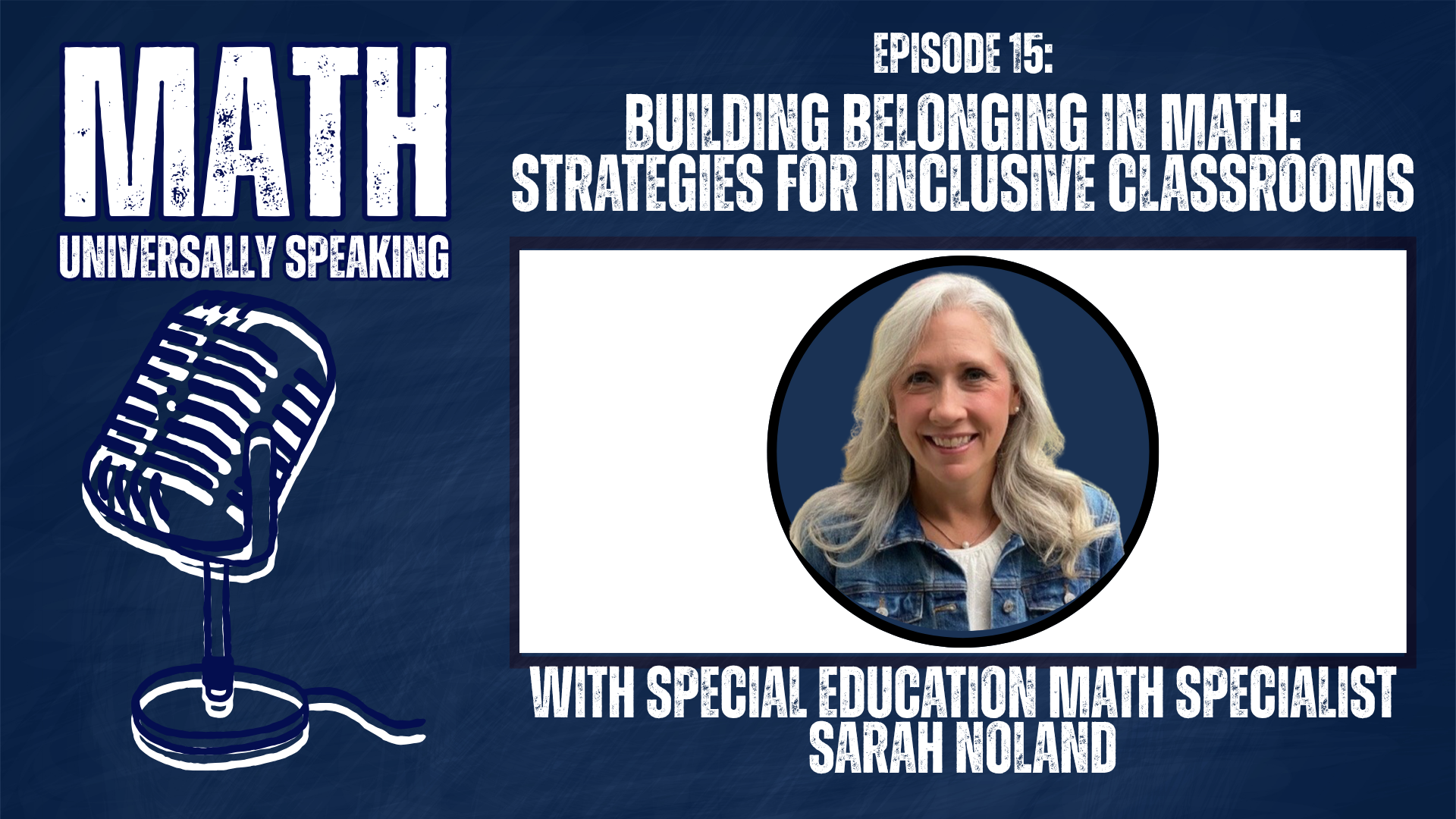





Episode 15 Description:
In this episode of Math Universally Speaking, Ron Martiello sits down with Sarah Noland, a special education math specialist from Maryland, to explore how Universal Design for Learning (UDL) can transform math instruction. Sarah shares her expertise in supporting students with disabilities, aligning IEP goals with the Standards for Mathematical Practice, and building inclusive classrooms where every learner can thrive. Together, Ron and Sarah discuss the importance of belonging, practical strategies teachers can use to make math accessible, and the role of high expectations in fostering student confidence. This conversation offers valuable insights for educators, instructional coaches, and administrators committed to equity in mathematics.
Connect with Sarah on LinkedIn: https://www.linkedin.com/in/sarah-noland-449268231/
Transcript
Building Belonging in Math: Strategies for Inclusive Classrooms: An Interview with Sarah Noland
Episode Transcript — Season 2, Episode 15
Introduction:
Welcome to Season Two of Math, Universally Speaking, where we believe every student deserves access to meaningful math through strong, equitable instruction. I’m Ron Martiello, instructional coach, former administrator, and co-author of Conquering Math Myths with Universal Design. Your guide as we explore the intersection of high-quality math instruction and inclusive practices. This season, we’ll continue to bust common math myths, share practical strategies, and highlight stories from educators from all over the world. Whether you’re a teacher, instructional coach, or administrator, you’ll find ideas here to help all students thrive. Let’s keep building a community of educators who believe that math is for everyone. This is Math, Universally Speaking.
Ron:
Hello friends. This is Ron Martiello, and welcome to another episode of Math, Universally Speaking. I have another very special guest today. We have Sarah Noland, who is a special educator from the state of Maryland.
Hi, Sarah.
Sarah:
Hi.
Ron:
Sarah, could you just take a few minutes to tell us about yourself and the role that you play down there in Maryland?
Sarah:
Sure. So my name is Sarah Noland. I am a special education math specialist in the lovely state of Maryland. I currently serve all schools in the district, K–12, and really the main focus of my job is to ensure that we are providing accessible mathematics for all students. I always talk about, within my role, focusing on programming for students with disabilities—students who receive special education services in the area of math—and really trying to create environments where they feel like they belong, that they have an entry point, and that we are proactively thinking about how we’re going to address their needs. The IEP often tells us exactly what we need to do, but even within the classroom, we have to really pay attention to how the student is responding to instruction. Within my role, I support teachers through coaching, modeling, and really trying to build—confidence, in a way—but also capacity so that teachers feel that they can meet the needs of the students sitting in front of them.
Ron:
So Sarah, I’m really looking forward to unpacking all of this in our conversation, but I do have to tell our listeners, it’s kind of funny how we’ve gotten connected. Dr. Rufo and I had written the book Conquering Math Myths with Universal Design. We put it out there. We’re on LinkedIn, we’re on Facebook, we’re on Instagram. And you were one of the first people who said, “Hey, I’m running a book chat on Conquering Math Myths with Universal Design.”
Sarah:
Oh, yeah. I was listening to another podcast called Think Inclusive, and I think the book had just been published when you and Jenna were being interviewed by Tim Villegas. I was like, “Oh my gosh,” listening to the two of you. I thought, I have got to read this book. So I purchased the book and read it, and I had to come to the district and pitch the idea to run a couple of book studies. I was able to find a supervisor who had funds, and she purchased 50 books for me. It was an easy sell when I was talking with the supervisors, just saying, “I want to do this book study.”
We had the full math team: elementary and secondary supervisors, elementary and secondary specialists, an equity supervisor, and a special education supervisor. We had everybody on the team read the book first, and then I facilitated the book study with 25 teachers in May. It was amazing. I know the book says K–8, but we opened it up to all teachers of mathematics. We ended up with teachers teaching AP coursework, algebra two, geometry, because ultimately, chapter eight addresses a lot of the work that we as a math leadership team have been working toward over the years.
When we all read chapter eight, it was concise, yet you and Jenna were able to talk about many district issues, one of them being dismantling segregated math classrooms. For whatever reason, if a student is perceived to have very discrepant math skills, or if their needs are more complex, pacing often becomes a reason for segregation. We as a math team try to combat that, providing teachers with information and data on why we need inclusive mindsets in general education classrooms. One example is that our district data shows that when students move to self-contained or segregated classrooms, they may regress or lose skills.
IEP teams ultimately make decisions for students to receive services in self-contained environments, often from a place of care, and we honor that. But when I get involved—working with teachers and students—I advocate for what it will take to move students back into general education. Sometimes it’s an easy question, sometimes more challenging, but it has to go back to the IEP team. It’s not just my belief or one teacher’s belief; it’s about the team.
Where we are now is building everyone’s understanding of why we need to think of math as a subject like social studies or science. We dismantled segregated social studies and science classes years ago—they don’t exist. Why can’t math be the same? Through the MTSS model, we can provide math instruction for all students in general education, with supplemental instruction as needed.
Ron:
I have to say that was a labor of love for my co-author because she’s dedicated her life to that work, and she’s taught me so much. As the general ed teacher in the duo, I am always asking, “How can we provide those supports in the general ed classroom so that students are supported there?” It’s not just about the moment; it’s about the student-centric experience.
Sarah:
Yeah. Sometimes students are placed in self-contained classrooms, and nobody evaluates if it’s truly working. The secondary math supervisor I work with talks about how special education is one of the most expensive interventions, yet we’re not evaluating the impact. If students are in a classroom, possibly one-on-one, and we know they’re regressing in skills, is it working?
I am part of conversations where, depending on teacher reports, I might say, “It sounds like we need to intensify.” Students may need supplemental or one-on-one instruction, or small group instruction within general education. We then look at the data—come back in six to eight weeks to see if the student responded. Are they making the same progress they were in general education? As a district, we want decisions based on data versus solely from the heart.
Another chapter in the book, chapter three—the Master Myth—really resonated with me. Before reading the book, I was already looking at how students feel about math, especially when receiving math support. For three years, we’ve implemented short cycles of math support in middle schools, connected to current learning and prerequisite skills. We realized students needed opportunities to share their feelings and understanding about math support.
Reading chapter three and the UDL toolbox with math identities was right on the path of where we were.
Ron:
You run into challenges coaching teachers not just on math content but also on making it inclusive. What are some entry points you use in these conversations?
Sarah:
One of the easiest entry points is the Standards of Mathematical Practice (SMPs). When talking about students with IEPs, it’s a common starting point. We’re responsible for developing student behaviors through intentional teacher moves. For students with IEP goals in math, this helps teachers move away from just rote skills. Procedures are important, but we must consider student thinking, understanding, and tool use.
For example, if a student is doing a 4×2 multiplication problem, we ask: Do they understand multiplication? If yes, can we teach them to use tools—calculators, multiplication charts, graph paper, or area models? We often default to algorithms, but the entry point for some students is understanding tool use.
Years ago, I attended a conference session about writing inclusive IEPs. The math examples aligned with SMPs, like “making sense of problems” and “using tools.” From there, I researched using SMPs in IEP goals. Dr. Rachel Lambert’s website Mathematizing for All has resources, including writing IEP goals aligned to SMPs, as do Rethinking Disability and Mathematics and Fostering Math Practices.
I put together professional learning for teachers on writing inclusive IEPs. When I coach teachers on SMP-aligned goals and objectives, inclusion is promoted. Students are more likely to stay in general education because their IEP goals align with classroom instruction.
Ron:
Sarah, this is why I asked you on the podcast. SMPs transcend grade level and prevent taking thinking away from students. Instead of just teaching the algorithm, you put thinking first, giving students agency with strategic tools and structure.
Sarah:
Exactly. With “Making Sense of Problems,” objectives become about thinking. Five years ago, IEP goals were often about solving a set number of word problems correctly. Now, objectives ask: Can the student explain the problem, explain what the numbers represent, create representations, or select the correct representation from choices? Word problems are intimidating for many students, but routines like the “three reads” strategy help students make sense of them.
Ron:
I love numberless word problems, co-crafting questions, and scaffolding scenarios. For example, changing the unknown in “add to, take away” problems while keeping characters the same gives students multiple ways to think. SMP one offers so many entry points for inclusion.
Sarah:
Absolutely. If we steal thinking opportunities by just having students do calculations, they disengage. Properly structured objectives engage students like everyone else.
Ron:
What’s your wish for students?
Sarah:
I wish students could enter math classrooms feeling safe and like they belong. Planning often boils down to those two things. Are we fostering a culture where students feel received, not sorted? For students with disabilities, this is critical—they are often automatically labeled. We need to focus on progress, even small steps, and honor individual learning trajectories.
Ron:
Wish away.
Sarah:
I want learning progressions to be honored. It’s okay if a seventh grader can’t solve a division problem or a one-step equation. How can we help them without making them feel “less than”? Minor teacher moves can inadvertently send the wrong message.
Ron:
Exactly. Those minor moves matter. Highlighting them allows teachers to adjust. That’s why your support is so valuable.
Sarah:
Every teacher is in a different place. Students they now have in general education may have been segregated ten years ago. I come alongside teachers to reassure them—they’re not alone. Together, we can plan so students are included and have entry points to communicate understanding. With support, teachers can do it. We just need to shift planning and instruction.
Ron:
All right, Sarah. Thank you so much for being on the podcast. Before you go, where can people find you?
Sarah:
Oh, I’m mostly on LinkedIn right now.
Ron:
That’s good enough. Please look Sarah up on LinkedIn—you can direct-message her with questions. She is a valuable resource and has been brave to share her expertise today.
Sarah:
Thank you.
Ron:
Thank you very much. Friends, on Math, Universally Speaking, I wish you well today. Keep learning, listening, and moving the ball forward so all students have a place in the math classroom. Take care.
Closing:
Thanks for tuning in to Math, Universally Speaking. If today’s episode got you thinking, inspired a strategy, or challenged your mindset, I’d love to hear from you, and so would our growing Math Community. Let’s keep the conversation going on social media using the hashtag #MathUniversallySpeaking, or connect with me on LinkedIn. You can also follow us at Math, Universally Speaking on Facebook and Instagram. Don’t forget to subscribe at mathuniversallyspeaking.com to get updates delivered to your inbox. Follow the podcast on Apple Podcasts, Amazon Podcasts, Castbox, or Spotify so you don’t miss an episode. Remember, math is for everyone—and together, we can make that a reality. I’m Ron Martiello. Take care.
💬 Professional Development Questions
- Belonging: How can we intentionally design our math classrooms so that every student feels safe, valued, and included, particularly students receiving special education services? What specific practices help foster a sense of belonging for all learners?
- Developing Inclusive Goals for Students: How can we write IEP goals and objectives that align with the Standards for Mathematical Practice (SMPs) to support inclusion in general education math classrooms? What strategies help ensure these goals promote thinking and understanding, rather than just rote procedures?
- Student Identities: In what ways can we recognize and leverage students’ math identities when planning instruction? How can we honor their experiences, strengths, and preferences to build confidence and engagement in mathematics?
References:
Mathematizing4All. (n.d.). Blog – Mathematizing4All. https://mathematizing4all.com/blog/
Lambert, R. (2024). Rethinking disability and mathematics: A UDL math classroom guide for grades K-8. Corwin.
Rufo, J. M., & Martiello, R. (2024). Conquering Math Myths with Universal Design: An Inclusive Instructional Approach for Grades K–8. ASCD.
 Math, Universally Speaking
Leave a comment