

We work with schools, organizations, and families across the country and beyond to transform our educational system into one that is accessible, engaging, and meaningful for ALL students.
Description:
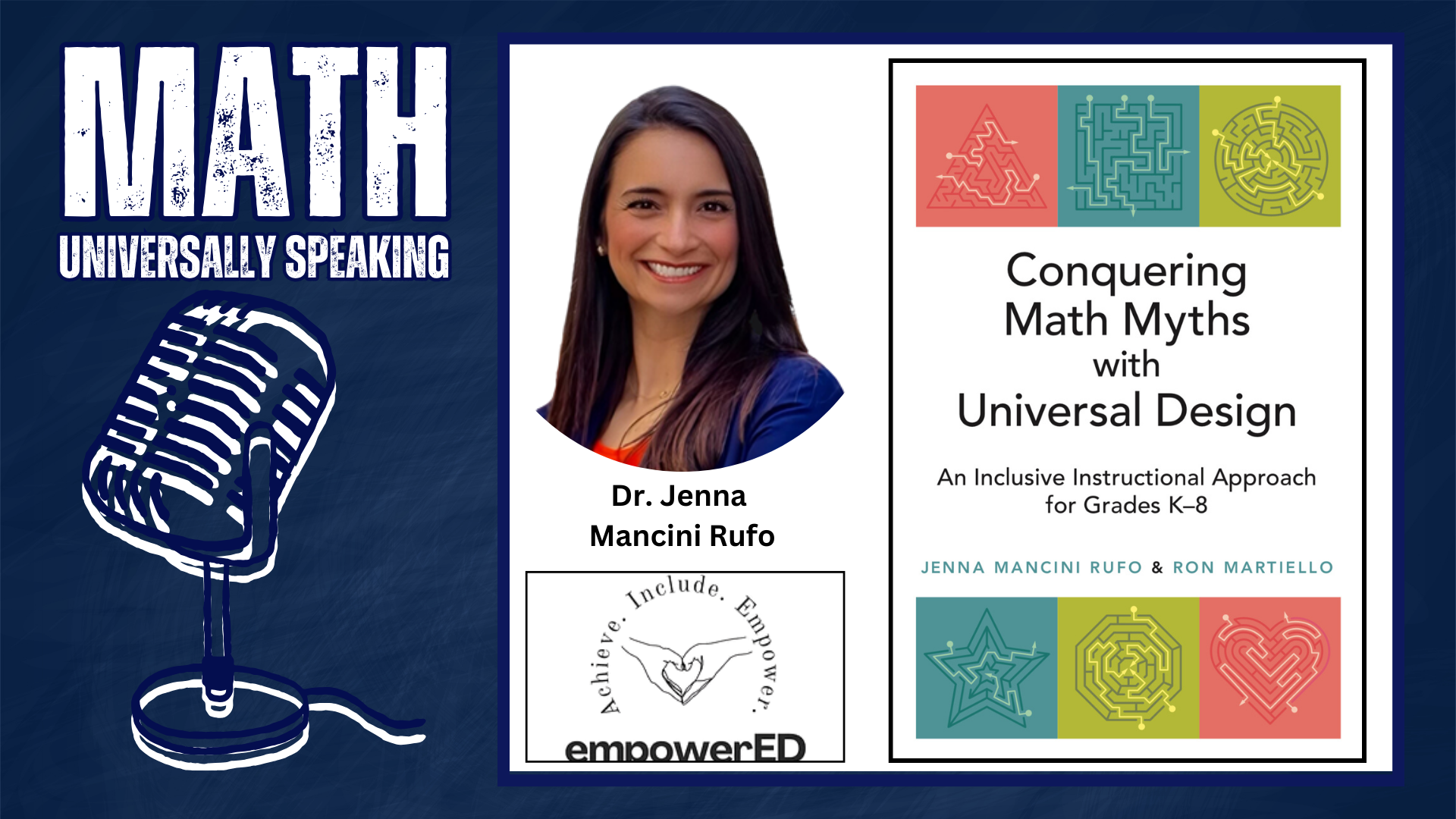
Dr. Jenna Mancini Rufo-Conquering Math Myths With Universal Design
In this special episode of Math Universally Speaking, host Ron Martiello sits down with co-author Dr. Jenna Rufo to reflect on their collaboration on Conquering Math Myths with Universal Design. Together, they unpack the inspiration behind the book, share personal stories from the field, and explore how Universal Design for Learning (UDL) can transform math instruction for all students. It’s a candid, thoughtful conversation about equity, inclusive eduction, and the power of high expectations.
Join Ron and Jenna as they challenge assumptions, celebrate progress, and invite you to be part of the movement to reimagine math instruction.
Follow along using #MathUniversallySpeaking and subscribe on Apple Podcasts, Spotify, Castbox, or Amazon Music. 📚 Learn more about our book: Conquering Math Myths with Universal Design 🎧 Available now on Apple Podcasts, Spotify, Amazon, and Castbox!
Transcript
Dr. Jenna Mancini Rufo-Conquering Math Myths With Universal Design
Ron
Hello math friends. This is Ron Martiello, and welcome to math. Universally speaking, we have a very special event today because we have our very first interview on the podcast. And I couldn’t think of anyone better to interview today than my co author, Dr Jenna Mancini Rufo, Hi Jenna.
Jenna
Hi Ron. You’re really my hype man over there today. Thank you. Oh, well,
Ron
In a minute, I’m going to ask you to brag a little bit about yourself, because you have done so much in the area of education. So why don’t you start us off? Can you share a bit about your professional journey and what’s led you to launch Empower Ed?
Jenna
Yeah, thanks, Ron. So I spent most of my career in special education. I started out as an inclusion facilitator at a public middle school in Massachusetts, where I was responsible for coordinating services for students who had some of the most significant disabilities in school. And when I moved back to Pennsylvania, where I’m from, it was a little surprising to me that a lot of the special education practices that we engaged in in this area were not comparable to what I was used to from when I started my work in Massachusetts. So ultimately, I decided to pursue my special education administrator certificate, became a special education supervisor and then director and assistant superintendent in the same district as you where I met you, Ron, we both kind of had parallel paths, serving in different capacities in that district. And then in 2020, transitioned into starting my own consulting business in power ed, and now we are working in about 17 states across the country, also doing some remote work in Australia, really supporting schools to become more inclusive, more engaging, and supporting students with disabilities in the general education classroom.
Ron
And you know, Jenna, it was a pleasure working with you at our district. You taught me a lot there, and you definitely had an impact on the organization, and it still resonates today. So let me ask this, what fuels your passion for inclusive education? You know, as you’re moving forward, as your journey has continued.
Jenna
My sister. She’s How old is she now, 40? About 40 years old now, I think, and growing up, my sister had a disability, and I really saw, I think, a lot of the injustices and inequities that she faced, both in the education system as well as in the medical field and society in general. And so my sister Nina really pushed me forward and inspired me to go into special education. So I think that that’s really what continues my passion, and what helps my passion continue to grow is being a family member and having that perspective and additional to the professional one.
Ron
And that’s what resonated with me when you were working through trying to implement more inclusive practices in our district, your story really helped to sell it gave us your why, and we greatly appreciated that. So let’s fast forward, because in the recent years, I’ve been able to collaborate with you on conquering math myths with universal design, and we’re very proud of the book. It launched in August. So excited. So let me…
Jenna
I’m super proud of it, Ron, and I feel like, you know, this is my third book over the past several years that I authored, and it’s really, I think, one of probably my favorite ones, mostly because of the collaboration that went into it. And I feel like I learned so much in this process, I learned a lot from you, and I think we both had sort of that mutual experience of feeling like we learned from one another as we were creating it.
Ron
So on that journey, one of the things we do talk about is like our math identities. How did this shape your math identity?
Jenna
Oh. So I think in terms of my math identity, and it’s in the book, and yours is as well, kind of those stories that we carry with us from childhood. And I remember one experience in particular, when I was in third grade and having to stay in from recess to complete my math because I didn’t fully understand the page, and just kind of how ashamed and embarrassed I was about that, and that really did stick with me. And I think that I personally closed off some opportunities in terms of taking more advanced coursework or AP, because I felt like, you know what? I don’t know if I can hack it, and it wasn’t really until I started becoming a teacher. And at that first job I had, I did a math intervention program after school for some students with and without disabilities who were at risk of, you know, not achieving to their highest potential in math. And that was the experience that got me thinking, You know what? I actually am a math person. I do like teaching math. I enjoy figuring out how to break down some of these complex topics. So I think I went from being someone that really wasn’t that into math, tried to steer clear of some of those more challenging math experiences to someone that actually enjoys teaching it, enjoys learning about it, as well as we continue to learn how to best reach students and teach them with what we know now.
Ron
I have a similar story. Math was that love hate relationship I had over the years. I was good at it some years and the other years, it knocked me down, and eventually I find myself here talking to you on this math podcast and have co-authored a book with you. It doesn’t happen overnight. We don’t just add water and like, Hey, we’re a math person, or hey, we have this positive math identity. It’s taken work and time for us to develop that, that love for math when we can see deeper. And as I think about why we wrote the book. That’s what we want to share with others,
Jenna
Right? And I think Ron, when we had this vision, we kept that in mind. So we have this idea of there’s a lot of people, particularly at the elementary level, who don’t consider themselves to be math people that are then in the position of having to teach a subject which they themselves might not be comfortable with. So really, a lot of the goals that we had when we were putting this together was it would be something that was accessible, that’s practical, that offers a lot of strategies for teachers that they can immediately turn around and use.
Ron
So getting back to the book, we put our myths out there first, and then we work off of different myths. Can you tell me one myth that you feel is just hanging out there and it’s just like, you run into it every time, and you’re like, man, if we could just get over this myth, what would that be?
Jenna
Yeah, and I don’t think you’re going to be surprised by my answer. So it is the myth that we close our book with, which is the myth that all doesn’t really mean all the myth that we have these statements on our school district websites of we believe all children can learn and everybody can achieve at high levels, but when we actually look at the practices that we’re engaging in, does that really support what that mission or vision claims to be? And I think that this one also really goes hand in hand with what we open the book with this idea of the myth of the math person, that math is either for some people or it’s not so you either got it or you don’t. For our students who have more significant needs, be it because of a disability, because of a language barrier, whatever the reason might be, there is a perception that they just can’t. So instead of raising the expectation, along with raising the supports, what tends to happen is we water down or reduce the expectation, and sometimes it might be with a good intent, so it might be out of this place of, well, they can’t possibly do that and it’s developmentally inappropriate. Or, you know, how could we possibly expect this child to be able to achieve this when they come from this background, or they can’t speak the language, or they have a disability, and when we make those assumptions, regardless of whether or not they are grounded in a good place or a place that’s not malicious in any way, the impact is the same. So we still see a negative impact on reducing those expectations. And then, rather than providing supports for the students to meet a high expectation, we just decide that they can’t do it at all.
Ron
We can still keep the integrity of the math, yes, we can keep the goals where they need to be, coaching kids up, providing those scaffolds going in, understanding. And this is, again, something you taught me so much about, is every learner is a variable. I mean, the variability of the learners in your classroom, you need to go into it understanding that variability. And one of the things that I’ve heard you say over and over again is the kids at the margins, the kiddos who are here at the at the who are early in their learning, versus kiddos who are later in their learning, and being able to proactively be responsive to those ends. And I’m sure that would help everybody in the middle?
Jenna
Yep, absolutely. I think you said that beautifully. And I think one of the things you know you mentioned this is what you learned from me. I think what I learned from you, and what I continue now as I’m working with schools, working with teachers, to emphasize is this idea of focus and coherence and being able to use those ideas to drive our instruction. So one of the things that we talked about, and we emphasized in the book, was focus is really, what are the topics that need to be studied more deeply, and then coherence is, how are those topics relating to one another from year to year. And so when we have students who are in our classrooms who might not be functioning right at grade level or where we need them to be, there is this very real pressure that we have to cover the content. We have to get through all this curriculum. So let’s kind of race through the book and page turn, and hopefully they get it. But you know what I got to get through? I have these pacing guides, whereas if we take a step back and we think about focus and coherence, we can spend more time on the standards that are most important or most critical for those students as they advance through the grades. And it’s not saying that some of those other standards that are additional or supportive aren’t important, but when we’re considering that we have a finite amount of time and we have students who have very real gaps and needs, we have to be judicious in the approach, and we have to really think thoughtfully, Plan intentionally, to make sure that we are addressing those highest leverage, highest impact standards.
Ron
Coherence is a big topic in my work. As I try to pull the veil back from teachers, they get so focused and hyper focused on the standard in their grade level. But really there’s these kiddos are coming with some knowledge. And if there are gaps, like, don’t put the toll booth up, don’t put the toll booth up and say, Oh, they can’t go any further unless they learn all of the previous grade level stuff. It’s like, let’s create some on ramps. Let’s create some just in time learning. You know, if you know, you have some type of lesson coming up on fractions like look back, be proactive. Look back at those standards that build toward that lesson. And hey, maybe I need to teach a little mini lesson here before I start introducing this new concept to my kiddos. So it’s really if they understand how it’s built. If teachers can understand how to design it, we can definitely keep all those kids in the game and practicing high levels of mathematics.
Jenna
And Ronald, I think you’re touching on one of the other myths that we talk about, the myth of prerequisite skills. So this idea that until you master the most foundational things, there is no way that you could possibly go on or possibly access grade level learning. And I think one of the conversations that the two of us have had a lot is that we are not advocating for, you know, oh, math, facts, automaticity, that stuff’s not important. It is. It is important that students learn that, but we also can’t use that as the gatekeeper to prevent them from accessing grade level curriculum. So the challenge becomes, how do you address those foundational skills while simultaneously providing that exposure and access to the general curriculum? And I think that’s the hardest part of all of this with a limited amount of time in the day. How do you do all of that? But the reality is, if we only focus on those foundational skills, and all we’re ever doing is drilling math facts or looking at how to read an analog clock or counting change, we are missing so many more important skills. And for our students, you know, I think a lot about our students who have more significant needs, intellectual disability, autism, of course, we know that there’s negative impacts there when we’re focusing most on functional skills, but even our students who have learning disabilities, who have what’s considered more high incidence or more common disabilities, we can’t continue to just live in that space of let’s drill the facts. Let’s work as work on these foundational skills, because for those students, many of them have the desire, the expectation to go to college, to continue their education, and if we don’t even provide them access to that grade level content, some of the decisions that we’re making for these kids at a very young age set them on a trajectory where they’re never going To be able to achieve that ultimate goal that that they could achieve if they had the correct exposure and access.
Ron
And so that kind of leads me into our next question, the myth of the single score, which is perpetuated by like the gold star myth, or the one way myth, there’s only one way to do it, and that’s what I’m testing you on, or just the simple thumbs up, thumbs down. Myth, like all of those myths that revolve around assessment, but the single score myth is that that can be the gatekeeper that you’re talking about. We also talk about assessment with a heart. So what kinds of strategies do you see as being useful as we try to kind of tell the story of the child and use assessment with a heart?
So I think if we start with the formative assessment piece, so what you’re doing in the moment to assess that student, and really what we should be looking at is what types of engaging strategies, multiple options. Are we providing students so that they can show us what they know in a way that is meaningful to them? I’m thinking of an area and perimeter example that you and I were working on for something else, for another session, and really what what we got to at the end of this was, rather than, let’s just turn the page complete these workbook problems that are here, we have to think of alternate ways that we can demonstrate that concept of area and perimeter, like taping down tiles on the floor, and counting those tiles up to demonstrate area, and then to demonstrate perimeter by going around them, like using Cheez Its to build shapes, like using tiles. So I think that it starts this idea of assessment. So it starts with providing multiple tools and options for students to explore what that doesn’t mean. So I think it can be misinterpreted sometimes as well. We’re just going to have this completely constructivist classroom, and it’s a free for all, and you pick whatever you want. Again, that’s, I know that’s not how you feel. It’s not how I feel either. We have to start with that direct instruction in terms of here is the concept: let’s explicitly teach it, but offer them multiple choices to access that content, to show us what they know. So I think that’s the first step with the formative assessment. And then when we get to summative assessment, the tests, the quizzes. I think this sometimes is where people have a hard time, because we think that if there’s a child who needs modifications or who needs some accommodations, that somehow it is not going to be fair to the other kids, that we’re making it easier. And I think in this context, it really does require a little bit of shifting in your thinking rather than thinking of this summative assessment as this is, you know, the be all and end all. It’s going to rank my students and show who has it and who doesn’t. Ultimately, the goal is to learn and to learn at your highest level. So if we have to make some adjustments to the way that students learn, that should not be viewed as a negative thing. Of course, we have standardized tests, and I think that sometimes people want to make sure that students are exposed to that method of testing. Sure, fine. I understand, you know, we don’t want them to see something for the first time, but ultimately, our goal is for students to learn. It’s not to sort them into you know, these are the blue birds. These are the ones who have everything. Get the gold star, like you said. And then there’s our kids over here, who are kind of at the bottom of the pack, so it does require that shift, and your goal has to be learning, not the score on a test.
Ron,
Yeah, you talked about standardized tests and how we can flip that script with a standardized test, is doing an interview assessment at the end. How about hey, you know what? You had a kiddo who did not perform as well as they thought they might, or you thought they might, or you may have a question, like, I really don’t understand what their what their thinking is, and so I need to sit down, sit with we want to sit with them and kind of get what they were thinking. And sometimes we can figure out what their thinking was just by having a simple conversation, rather than sorting and label and sending in the child onto a different trajectory. So even if we do have to, we definitely have to adhere to a standardized test. But how can we do it with a heart and put the focus on the learning so that kiddos get that actionable feedback at the end, right?
Jenna
And I think looking at growth, so not just looking at, you know, did you achieve proficiency on this test or not, but maybe you were in the below basic range, and over the course of the year, you approved, improved from below Basic and now you’re in basic. That’s growth. It’s not, maybe where we want it to be yet, but I think we have to really make those reasonable goals for our students and for ourselves and and recognize that students are making progress, and the be all and end all is not the test,
Ron
So we adhere that tests are part of the system and everyone’s working within that system. What I’m going to ask you now is, you know, what is the role of our administration? The role of the people who are able to make the decisions so we can foster this sense of math is for everyone, everyone’s included, let’s keep the integrity of the math while being responsive for students.
Jenna
Yeah, I love that question, and I think it really comes down to you have to walk the talk. So if we are truly saying that we believe all children can learn, we have a vision, we have high expectations for all then, as the leader, that is the expectation that we have to set, and we have to model that behavior. So that means when someone comes to you saying that I don’t know what to do with this student, I think they belong in a special ed math class, we have to respectfully challenge that, and we have to build a culture within the schools where we do see all students as capable and competent, and that’s not easily done. I think it’s much easier to teach someone instructional strategies or tools than it is to shape a belief system. And again, I don’t think that a lot of these assumptions are coming necessarily from a bad place. Impact is the same. So as the leader, I think it’s building a culture of high expectations with support, not just we’re going to make it hard, and you sink or swim, it’s challenging, challenging your staff when maybe they are coming to you with a thought that doesn’t necessarily match what the vision is of the school or the district, but doing so in a way that is respectful. And then I think also it’s important to really look at the structures that are in your school or your district. So are the structures that are in place? Are they setting up your students and your teachers for success? For example, if we decide that we’re co teaching math this year, have you provided your teachers with training on co teaching? Do we have dedicated planning time for these people to meet? I have heard it said, I’ve mentioned this before. This wasn’t my quote. It’s been said that inclusion is an easy thing to do poorly, and when you do it poorly, it reinforces the idea that it doesn’t work. So if we are implementing things like co teaching or like instructional or flexible grouping, and we’re not setting up those structures effectively, then we are reinforcing this belief system that it can’t possibly work, and we’re actually taking more steps backwards when we were really trying to move forwards and what we thought was something that’s going to be good. So I think it’s walking the talk. It’s shaping the beliefs and the culture of your school to be in alignment with that of the vision of the school and the district, and it’s making sure that those structures are in place.
Ron
Awesome. Also, I love how you talked about supporting teachers and making sure, because they make this go, they really do, and they’re working so hard, even those who are kind of like trying to work independently, those who want to like get started, or maybe they do have a great supportive system, but they really do want to get started in this work and grow themselves. Where do they start?
Jenna
So I think maybe it might be slightly different if we’re talking teachers versus if we’re talking leaders. I think in a lot of ways it’s harder if you’re a teacher, because maybe you have these ideas, you have this knowledge, but there are barriers in your system that are preventing you from accessing training or from, you know, going through with some of these ideas that you might have about inclusive practices or co teaching, or whatever it might be. So I think for teachers, it’s about finding those allies in your system, whether there are other teachers, whether they’re leaders and really trying to build a little bit of a critical mass to advocate for what it is that you need. So if it is additional training you need, if it is some adjustments to the structures, I always also advocate for teachers to have a conversation with your administrator, to talk to them, to share if there are concerns the administrators should be there to help you achieve your goals. So having that open relationship, and I think, with the leaders, when we’re looking at where to start, it really starts with reflection. And it starts with looking at your own beliefs, your own philosophy, and then looking at the structures that are in your school that either support or hinder where you want to go. So I think for leadership there, it’s more of an autonomous piece, because you have to really critically look at not just your own belief system and your practices, but then how does that interface with the rest of the organization, with the rest of the district? So I think it’s really starting with that piece of reflection, and then from reflection, gathering data to come up with an action plan.
Ron
That’s some pretty powerful information from someone who has worked at all of those levels, from a teacher to supervisor to assistant superintendent. So thank you very much for sharing those tips. If they, if they, if our listeners wanted to learn more about you and empower Ed, where could they go?
Jenna
So you can go to my website. It’s www, dot Empower Ed, like empowered school.org, and you can find a list of services that we offer, professional development. We also provide student specific supports. So sometimes we consult with schools and families if there’s a child who is experiencing barriers to inclusive education, to really support those teams in finding ways for the child to access the general curriculum. So the website is the best place to go, obviously, if we’re talking about math, our book conquering math myths with universal design, yeah, if you guys can see Ron, he’s like raising the roof over here. You know, that’s a great resource. And I have another book that I would also recommend, reimagining special education, which talks a lot about some of those belief systems, the structural pieces that I mentioned.
Ron
I was hoping you’re gonna throw the other books in there, just a little plug at the end. There you go. There you go. You know what? Jenna, I have been very fortunate to grow up as a teacher and a principal around some really great people. You being one of them, and I greatly appreciate your partnership in this work. And I know that there are others out there who share our passion, who share our mindset, who do this because we want to make things better for our students, and we want them to have that great school experience so they can accomplish their hopes and dreams. So I want to thank you for being part of my journey and for also coming onto the podcast today.
Jenna
Well, the feeling is mutual, Ron, and I think it’s like you have said, I have been really lucky to work alongside some amazing administrators and teachers. You being one of them, I’m happy that our paths crossed again to have this book collaboration, and I’m really looking forward to providing some more training and supports to districts around Universal Design and math. And I think that’s just one other thing, if people wanted to reach out to me, to you, that we are starting to collaborate on some of these projects and to work with schools and districts on these strategies as they pertain to math.
Ron
Well, again, thank you, Jenna, for joining us on the podcast. Thank you to all of you out there giving us your valuable time to listen to the conversation. We hope that you’ll pick up a copy of conquering math myths with universal design and continue to pick up the work to advocate for your students so that we can provide equitable, inclusive math instruction for all students. Take care. Thanks for joining me on math University speaking. I’d love to hear what resonated with you today. Be sure to subscribe to the website to get.
💬 Professional Development Questions
- Which math myth discussed in the episode challenged your current beliefs or practices? How might shifting this mindset impact your students’ access to meaningful math learning?
- How can applying Universal Design for Learning (UDL) principles help ensure that all students—not just some—engage with grade-level math content?
- What is one actionable step you can take this week to break down barriers in your math instruction and build a more inclusive classroom environment?
Other Resources

Official ASCD Study Guide for Conquering Math Myths with Universal Design
Click on the link above and find the study guide to support your professional development conversations.
References:
Rufo, J. M., & Martiello, R. (2024). Conquering math myths with universal design: An inclusive instructional approach for grades K–8. ASCD.
 Math, Universally Speaking
Leave a comment